


Herbs, Slippery Elm
Slippery Elm Tea: What It Does, How To Use & Is It Safe For You or Not?
What Is Slippery Elm Tea?
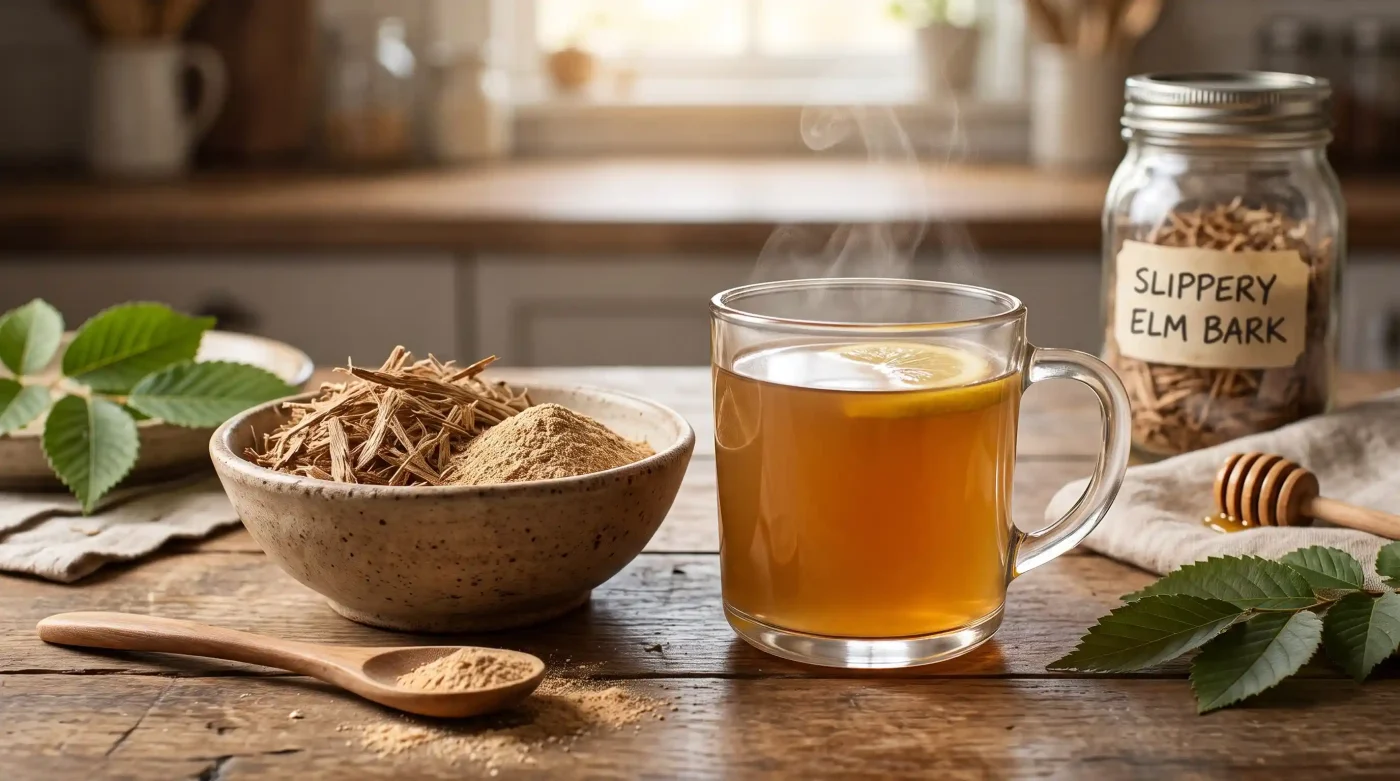
Slippery elm tea is made from the inner bark of Ulmus rubra. Only the inner bark is used. The outer bark is not. The bark feels soft when wet. It turns water thick and silky. That change comes from mucilage. Mucilage is a natural soft fiber. People have used this bark for the throat and digestion wellness for a long time.
Key facts
- Plant part: inner bark of Ulmus rubra (slippery elm)
- Thickness comes from: mucilage, a soft natural fiber
- Powder prep: about 2 minutes, no straining
- Cut bark prep: about 2 minutes, stir into warm water and drink right away
- Caffeine: none, since slippery elm bark is not a caffeine source
Slippery elm tea feels different from most herbal teas. Slippery bark turns water thick and silky. That change comes from mucilage. People have sipped this warm drink for throat comfort and digestive wellness for generations.
Making it is where most people go wrong. Powder clumps when it hits a full cup of water. The fix is simple, covered below.
What Does Slippery Elm Do in Tea?
In tea, slippery elm acts as a natural thickener. The inner bark contains mucilage, and the mucilage turns plain water into a smooth, gel-like drink.
How Slippery Elm Tea Feels and Tastes?
The flavor is mild, slightly sweet, and earthy. The texture stands out more than the taste. A well-made cup feels soft on the tongue and throat. The gel coats the mouth gently. Many people add a little honey or cinnamon if they want more flavor. A splash of warm oat milk can make it creamier.
Why Does Slippery Elm Tea Turn Thick?
The thickness comes from mucilage. Mucilage is a polysaccharide, meaning a long chain of sugar units. When it meets water, it swells into a soft gel.
A 1969 study in Carbohydrate Research found that slippery elm mucilage includes four sugar units:
- L-rhamnose
- D-galactose
- 3-O-methyl-D-galactose
- D-galacturonic acid
One of these sugars is rare. A 1971 paper in the Biochemical Journal reported that 3-O-methylgalactose had been known only in slippery elm mucilage until that time.
What Does the Research Say About Slippery Elm Tea?
Many questions about slippery elm tea are really about digestive and throat conditions. The honest answer is that the research is thin. MedlinePlus states there is no good scientific evidence to support the common uses of slippery elm. Michigan Medicine rates those uses at its lowest level: supported by traditional use, with minimal or no scientific evidence.
If you have ongoing stomach or throat symptoms, see a doctor rather than relying on an herbal tea. Think of slippery elm tea as a traditional warm drink, not a fix for a health condition.
How to Make Slippery Elm Tea From Powder
Powder tea takes about 2 minutes and needs no straining.
- Measure 1/4 tsp (about 500 mg) of slippery elm powder into a mug.
- Add 1 to 2 tsp of warm water and stir into a smooth paste.
- Pour in the rest of 8 oz (240 ml) of warm water while stirring.
- Stir thoroughly until the tea turns smooth, then drink it right away.
The paste step is what stops the lumps. Dry powder dropped into a full cup forms clumps that are hard to break up. You can also stir the same 1/4 tsp into 8 oz of juice or a smoothie.
How to Make Slippery Elm Tea From Cut Bark?
Cut bark is mixed the same simple way as the powder.
- Measure 1/4 tsp (about 1 g) of cut and sifted slippery elm bark.
- Mix it into 8 oz of warm water, juice, or a smoothie.
- Stir thoroughly and drink it right away.
| Feature | Powder | Cut and sifted bark |
|---|---|---|
| Prep time | About 2 minutes | About 2 minutes |
| Amount per cup | 1/4 tsp (about 500 mg) in 8 oz | 1/4 tsp (about 1 g) in 8 oz |
| Straining | Not needed; you drink the powder | Not needed |
How Can You Make Slippery Elm Tea Taste Better?
Slippery elm tea tastes mild, slightly sweet and earthy, and the texture stands out more than the flavor. To make it more enjoyable, stir in 1 tsp of honey or a pinch of cinnamon. A splash of warm oat milk, about 2 tbsp, makes it creamier. You can also whisk the powder paste into a cup of brewed chamomile tea instead of plain water.
Can You Use Tea Bags, Ice or Milk?
- Tea bags: Slippery elm tea bags work, but they hold a set amount, often around 1.5 g. Check the box for steep time, and press the bag before removing it.
- Iced: Make the powder tea as usual, let it cool, then pour it over ice. Expect it to thicken a little more as it chills.
- Latte: Whisk the powder paste into warm oat milk instead of water. Add a pinch of cinnamon, or 1 tsp of cocoa powder for a chocolate version.
Slippery Elm Tea vs Marshmallow Root Tea
Both teas turn thick because both plants contain mucilage. Michigan Medicine groups slippery elm and marshmallow together as herbs high in mucilage. The European Medicines Agency has published a monograph for marshmallow root.
| Feature | Slippery elm | Marshmallow root |
|---|---|---|
| Plant part | Inner bark of Ulmus rubra | Dried root of Althaea officinalis |
| Health Canada monograph | None | Yes, for the root |
| Our label prep | 1/4 tsp powder stirred into 240 ml warm water | 1 tsp cut root steeped in 240 ml hot water for 10 to 15 minutes, then strained |
If you want a steeped tea instead, Herb To Body marshmallow root is the simpler option.
Who Should Not Take Slippery Elm?
Three groups should skip slippery elm tea or check with a doctor first.
- People who are pregnant or breastfeeding: Its best course of action to avoide slippery elm during pregnancy and breastfeeding.
- People taking oral medications: Mucilage can reduce how much medicine the body absorbs.
- People with an elm allergy: If you have reacted to elm before, ask your doctor first.
Conclusion
Slippery elm tea is a simple, traditional drink. Its mucilage gives it a thick, silky texture. Powder is the quickest choice: stir 1/4 tsp into 8 oz of warm water once daily. Check with a doctor first if you are pregnant, breastfeeding or allergic to elm. For an easy daily mug, try Herb To Body Slippery Elm Bark Powder in 4 oz or 1 lb bags.
References
- MedlinePlus, U.S. National Library of Medicine. Slippery Elm.
- Michigan Medicine Health Library.
- Beveridge RJ, Jones JKN, Stoddart JF, Szarek WA. Some structural features of the mucilage from the bark of Ulmus fulva (slippery elm mucilage). Carbohydrate Research. 1969;9(4):429-439.
- European Medicines Agency. Althaeae radix (marshmallow root).
- Herb To Body. Slippery Elm Bark Powder.
- Herb To Body. Marshmallow Root C/S.
Frequently Asked Questions (FAQ)
No published source sets an ideal time of day. Two rules do apply. Keep to one serving a day, as the label suggests, and drink it at least 1 hour after oral medicines.
No research shows effects specific to women. The same facts apply to everyone, with one important difference: MedlinePlus advises avoiding slippery elm during pregnancy and breastfeeding.
Herb To Body sells slippery elm bark powder online in 4 oz and 1 lb bags, packed in the US. The powder works for both tea and smoothies.
One cup a day matches the label. The Herb To Body powder label suggests one serving a day, or as directed by a healthcare professional. MedlinePlus says there isn’t enough research to set a dose, so check with a healthcare professional before drinking it daily for weeks.
Disclaimer: *These statements have not been evaluated by the Food and Drug Administration. This product is not intended to diagnose, treat, cure or prevent any disease.
Slippery Elm Tea: What It Does, How To Use & Is It Safe For You or Not?
What Is Slippery Elm Tea? Slippery elm tea is made from the inner bark of...
Nov

Cilantro vs Coriander: Differences, Flavor & Uses
Coriander and cilantro are one of the most confusing spice-and-herb pairs. Coriander and cilantro come...
Nov
Fenugreek Tea: How to Make It, What It Tastes Like, and What to Know
Fenugreek is a popular herb often used in traditional home remedies for hair care, skin...
Nov
10 Winter Herbs and Spices for Tea and How to Brew Each One
Fall is slowly turning into winter. Days get shorter, and nights get colder. Leaves drop,...
Oct

Halloween Food Ideas: Easy Herbs and Spices for Party Recipes
Halloween is more than costumes, candy, and spooky decorations. It is a reason to gather...
Oct

Columbus Day 2026: History, Plants of the Columbian Exchange
Many foods and herbs we use today including chili peppers, cacao, vanilla, tomatoes, and potatoes,...
Oct

Vitamin C Powder: Forms, Dosage, Safety, and How to Choose
Vitamin C powder is a dissolvable supplement that is usually made with ascorbic acid or...
Oct

Goldenseal Root: Uses, Dosage, Safety & How to Buy It
What Is Goldenseal Root? Goldenseal root is a bitter yellow herb with a long history...
Oct
Andrographis Paniculata: Benefits, Herb Profile, Uses, Dosage & Safety
Andrographis paniculata is a bitter medicinal herb from the Acanthaceae family, often called “King of...
Sep

Patriot Day: History, Facts, and 9/11 Remembrance
Patriot Day is a day of remembrance. It is held every year on September 11th...
Sep

Olive Leaf: Benefits, Active Compounds, and How to Use It
We all use or have heard about olive oil. But did you know that the...
Sep
Labor Day Sale: Fresh Fall Botanicals
Update: The Herb To Body Labor Day 2026 sale ended on Monday, September 7, 2026,...
Sep
Astragalus Root: Benefits, Uses, Dosage & Safety
Astragalus root, also known as huang qi, comes from a plant in the pea family...
Aug

What Is Echinacea: Benefits, Active Compounds, Types, Uses and Who Should Avoid It?
When the cold season arrives, many people add a traditional botanical such as Echinacea to...
Aug

Elderberry (Sambucus nigra): What It’s Used For, Potential Benefits & Safety
Every autumn, the same scene plays out – someone at home starts sniffling. Through the...
Aug
Immune Supporting Herbs: Forms, Uses & Safety Guide
What is an Immune Support Herb? An immune-support herb is a plant traditionally used for...
Aug

Back to School Wellness: A Routine for the Whole School Year
The first bell of the school year changes a household’s routine overnight. Bedtimes shift earlier,...
Aug
Herbs for Women: Traditional Uses, Research Notes and Safety
Many women wellness seekers search for simple herbs to add to a daily routine. Some...
1 Comment
Aug

Oat Straw Tea: Benefits, Uses & How to Brew and Use Perfectly?
What Is Oat Straw Tea? Oat straw tea is a mild herbal tea made from...
Jul
Shikakai Powder: Benefits, Active Compounds, Uses and Safety
Long before bottled shampoo existed, people in South Asia reached for a dried legume pod...
Jul

Mugwort Tea: Benefits, How to Make It, Taste & Safety Guide
Mugwort tea (Artemisia vulgaris), also known as the “Mother of Herbs,” holds a storied place...
Jul

Wormwood Herb: Benefits, Side Effects, Uses, Compounds & More
Wormwood (Artemisia absinthium) is one of the most famous and intensely bitter herbs in traditional...
Jul

Wheatgrass Juice Powder: Benefits, Nutrients, Uses, Taste Comparison & Buying Guide
In a perfect world, we’d all eat fresh greens every single day. But reality hits...
Jul
Yerba Mate: What Is It, Benefits, Caffeine Amount, and How to Make It
Yerba mate is a traditional caffeinated beverage from South America made from the dried leaves...
Jul

Alligator Pepper: Flavor, Uses, Botanical Profile, Substitute and Buying Tips
If you heard the name “alligator pepper,” what comes to mind? Is it the same...
Jul

Green Black Walnut Hull & Extract (Juglans nigra): Benefits, Uses & How It Differs
When you’re looking for black walnut hull, you quickly notice two very different products. One...
Jul

Fourth of July 2026: History, Traditions, and a Safe, Fun Day
The Fourth of July is easy to picture. The grill is going. Music is playing....
Jun
Tongkat Ali Honey: Benefits, Taste, Uses & How to Take
Tongkat ali honey is honey mixed with tongkat ali root (Eurycoma longifolia, also called longjack)....
Jun