


Echinacea, Herbs, Immune Supporting Herbs
What Is Echinacea: Benefits, Active Compounds, Types, Uses and Who Should Avoid It?

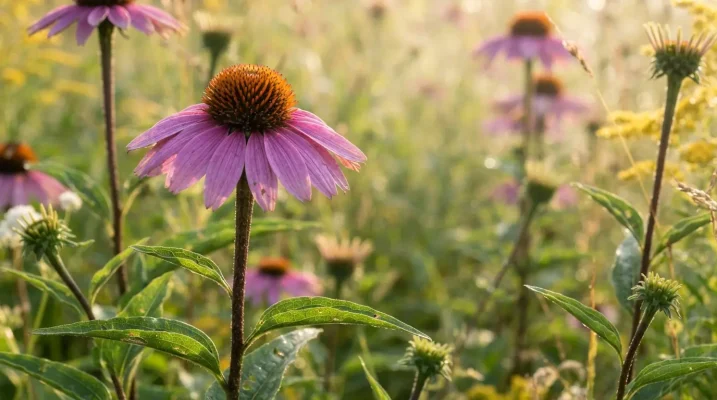
When the cold season arrives, many people add a traditional botanical such as Echinacea to their seasonal routine. Echinacea purpurea, also known as purple coneflower, is a North American herb with a long history of traditional use.
Echinacea products may contain the root, the aerial parts (leaves, stems, and flowers), or both. This matters because each part contains different natural compounds. Echinacea root contains alkylamides, while the herb and flowers provide compounds such as cichoric acid, flavonoids, and polysaccharides.
Short Answer: Echinacea may offer modest seasonal wellness support for some adults. However, research does not show that it reliably shortens an active cold, and results can vary by the species, plant part, preparation, and serving size used. (Source: NIH GOV)
What Is Echinacea?
This herb belongs to the Asteraceae family, which includes daisies, sunflowers, ragweed, and chrysanthemums. Its common name is coneflower because the flower has a raised, prickly center cone.
Echinacea plants are native to North America. In traditional herbal use, the root and aerial parts were taken as an herb. Today, Echinacea is sold as cut root, dried herb, tea, powder, capsules, and liquid Echinacea extract.
Several Echinacea plants grow in North America. The three species most often used in traditional herbal practice appear in the table below.
| Botanical name | Common name | Part often used | Notable compounds |
| Echinacea purpurea | Purple coneflower | Root and aerial tops | Alkylamides, cichoric acid, polysaccharides |
| Echinacea angustifolia | Narrow-leaf coneflower | Root | Alkylamides and echinacoside |
| Echinacea pallida | Pale purple coneflower | Root | Echinacoside and phenolic compounds |
These species are related, but they are not identical. A product made with Echinacea pallida root may contain a different compound profile than one made with Echinacea purpurea herb.
Root vs. Aerial Tops
| Plant part | Key compounds | Explanation | Best preparation |
| Root | Alkylamides, polysaccharides | Alkylamides are fat-soluble compounds that bind to CB2 receptors, or “locks,” on immune cells. They also create the familiar tongue tingle. | Tinctures, decoctions, powder |
| Aerial tops | Cichoric acid, flavonoids | Cichoric acid and flavonoids act as phenolic antioxidants that researchers study in oxidative-stress pathways. | Infusions, hot teas, powder |
| Flowers | Phenolic acids, flavonoids | Flowers add mild flavor and provide extra plant compounds. | Tea blends and infusions |
Bottom line: Echinacea root contains the tongue-tingling alkylamides. The herb and flowers, by contrast, provide a lighter, grassier cup and naturally occurring cichoric acid.
What Is Inside the Plant?
This herb contains several compound groups that researchers continue to study.
- Alkylamides. Root compounds that bind to CB2 receptors on immune cells, which may influence cytokine signaling.
- Cichoric acid. A phenolic acid found in Echinacea purpurea, especially in aerial parts such as leaves, stems, and flowers.
- Flavonoids. Compounds that act as plant antioxidants, studied in relation to oxidative stress.
- Polysaccharides. Water-soluble complex carbohydrates that researchers often study in plant extracts.
- Glycoproteins. The root provides these alongside polysaccharides in immune-cell studies.
- Echinacoside. A compound that E. angustifolia and E. pallida root provide in larger amounts.
In simple terms, echinacea does not turn the immune system on. Instead, it may support the way immune cells communicate with each other.*
For example, alkylamides bind to CB2 receptors, which may influence cytokine pathways involved in immune signaling. That is only a laboratory mechanism. It is not a promise that every tea, capsule, or tincture provides the same result.
Root vs. Herb
Choose the form based on your preferred preparation:
| Form | Common plant part | Best suited for |
| Cut root | Root | Decoctions and tinctures |
| Cut herb | Leaves, stems, flowers | Herbal teas and infusions |
| Powder | Root or aerial parts | Capsules, smoothies, and blends |
| Tincture | Often root or a root-and-herb blend | Convenient liquid use |
Root has a dense texture, so it works well in a decoction. The leaves and flowers are lighter, so they are better for a simple hot-water infusion.
Potential Benefits of Echinacea – What Research Says
The short version, with the honest hedges attached.
- Immune Support: Echinacea root provides alkylamides and polysaccharides, and research suggests it may support normal immune signalling.* (Source: pmc.ncbi.nlm.nih)
- What the Research Says About Seasonal Use: NCCIH reports that research on Echinacea and the common cold has produced mixed results, and any measured differences were small. Most trials ran 10 days on, then a short break. Laboratory research suggests that certain Echinacea alkylamides may bind to CB2 receptors, which are receptor sites found on some immune cells.* (Source: Pubmed)
- Cytokine Research: Laboratory work reports that echinacea extract has been studied for effects on TNF-alpha and IL-6 signalling in cell models. Human data stay thin.*
- Antioxidant Activity: Cichoric acid, flavonoids, and other phenolic compounds from Echinacea have shown antioxidant activity in laboratory testing. For example, research has measured radical-scavenging activity in Echinacea extracts and isolated cichoric acid.* (Source: NIH)
- May Provide Throat Comfort: A warm root decoction may ease a scratchy throat.*
- Seasonal Use: Some people use Echinacea tea, powder, capsules, or tincture as part of a seasonal wellness routine. However, clinical findings are not consistent across all Echinacea preparations.* (Source: NCCIH NIH)
- Skin/Topical Use: Coneflower root has been used historically for skin health, as a wash rather than a drink.*
- Stress and Mood: Narrow-leaf coneflower root has been examined in early research for its role during occasional everyday stress.* That evidence remains preliminary.*
What Studies Say About Echinacea?
- According to the National Center for Complementary and Integrative Health (NCCIH): Research on echinacea and the common cold is mixed, and studies have not clearly established whether it affects how often people catch colds or how long a cold lasts. (Source: NCCIH)
- Placebo-controlled studies: Results differ because studies use different species, extracts, plant parts, doses, and study designs.
- Laboratory research: Researchers have studied Echinacea compounds for immune signaling, cytokine modulation, oxidative stress, and receptor activity.
- Consumer takeaway: A dried-root tea, a tincture, and a standardized Echinacea extract are different preparations and should not be treated as identical.
Research suggests that Echinacea may provide a modest seasonal wellness benefit for some people, but outcomes are not consistent enough to make a guarantee.
How to Prepare Echinacea?
Follow the serving directions on the specific product label. Raw herbs and extracts vary in strength, so no single serving amount works as a universal guide.

Root Tea
The root is used in a simmered decoction rather than a quick steep.
- Add 1 teaspoon of cut echinacea root to 1 cup of water.
- Bring the water to a gentle boil.
- Cover and simmer for 15 to 20 minutes.
- Strain before drinking.
For a stronger cup, use 2 teaspoons in 1 cup of water, and follow your product label. Ginger, cinnamon, lemon, or honey can soften the earthy taste.
Shop Echinacea Purpurea Root C/S
Herb Tea
The aerial tops include lighter leaves, stems, and flowers, so they are usually prepared as an infusion rather than a decoction.
- Add 1 to 2 teaspoons of the dried herb to 1 cup of hot water.
- Cover the cup.
- Steep for 10 to 15 minutes.
- Strain and enjoy warm.
Shop Echinacea Purpurea Herb C/S
Echinacea Powder
Powder works as the most flexible format, and it suits capsules, smoothies, and herbal blends. Root powder is often chosen for its alkylamide content, while herb or tops powder may provide more cichoric acid. Above all, use the serving size printed on the package.
Shop Echinacea Root Powder, Echinacea Herb Powder, Echinacea Tops Powder
Important Note: Check the product label before you use the powder.
Side Effects and Safety Concern
Safety first: Echinacea may not be suitable for everyone. Safety can vary based on the preparation, serving size, medical history, plant allergies, and medication use.
Possible reactions may include stomach discomfort, nausea, headache, dizziness, or a skin rash. People who are sensitive to ragweed, daisies, chrysanthemums, or related Asteraceae plants should use extra caution. NCCIH notes that allergic reactions are possible. (nccih.nih.gov)
Talk with a qualified healthcare professional first if you:
- Take immunosuppressant medication.
- Have an autoimmune condition.
- Have received an organ transplant.
- Take prescription medication regularly.
- Are pregnant or nursing.
- Are considering Echinacea for pediatric use.
Where To Buy Echinacea?
Herb To Body provides cultivated Echinacea purpurea with the botanical name on the label. If you prefer a single-herb product, choose one that clearly lists Echinacea purpurea and the plant part used.
Final Thoughts
Echinacea is a traditional herb with a complex profile that depends on the species, plant part, and preparation you choose. Root, herb, powder, tea, and tincture each provide different naturally occurring compounds.
Research suggests Echinacea may offer modest seasonal wellness support, but results are not consistent for every product or person. Choose clearly labeled, responsibly sourced Echinacea purpurea, follow product directions, and check with a healthcare professional if you take medication or have a health condition.
References
- NCCIH – Echinacea coneflower Usefulness and Safety – National Center for Complementary and Integrative Health (NCCIH), NIH.
- NCCIH – The Common Cold and Complementary Health Approaches
National Center for Complementary and Integrative Health (NCCIH), NIH. - Burlou‑Nagy et al. – Echinacea purpurea: Biological and pharmacological activities, analytical methods, and quality control (2022)
- Gertsch et al. – Alkylamides from Echinacea are a new class of cannabinomimetics (2006) – PubMed.
- Gertsch et al. – Echinacea alkylamides modulate TNF‑alpha gene expression via CB2 receptors (2004) – Pubmed
- Raduner et al. – Synergistic immunopharmacological effects of N‑alkylamides in Echinacea purpurea extracts (2009) – PubMed.
- Pleschka et al. – Echinacea purpurea: Pharmacology, phytochemistry and analysis methods (2015) – Pharmacognosy Reviews; NIH PMC.
- Woelkart et al. – The Role of Alkamides as an Active Principle of Echinacea (2007) Planta Medica; Thieme.
- Endogenous levels of Echinacea alkylamides and ketones in human plasma after oral ingestion (2009) – PubMed Central.
- Bauer alkylamide enrichment and anti‑inflammatory activity in Echinacea angustifolia (2010) – PubMed Central.
- Echinacea‑derived alkylamides as complementary immunomodulators via CB2 and TLR4 (2026) – University of Western Australia Research Repository.
- Effects of Echinacea purpurea and Alkylamides on Respiratory Virus Replication and IL‑8 Expression In Vitro (2025) – Molecules (MDPI).
Frequently Asked Questions (FAQ)
Echinacea contains natural compounds called alkylamides and polysaccharides. In laboratory research, these compounds interact with certain immune cells and may influence how those cells send signals to each other.*
Short cycles are good to use, commonly ten days on, three to four days off. Continuous year-round use is not supported by the evidence and is not something we recommend.
The root is the alkylamide-rich part of the plant, which is why it produces the characteristic tongue tingle and why it is favored for tinctures and capsules. Traditional use centered on the root for short-term seasonal support. The aerial tops are the better source of cichoric acid.
Neither is better; they are different. Root carries alkylamides and glycoproteins. Tops carry substantially more cichoric acid. Many traditional preparations combined both.
Disclaimer: *These statements have not been evaluated by the Food and Drug Administration. This product is not intended to diagnose, treat, cure, or prevent any disease.

Vitamin C Powder: Forms, Dosage, Safety, and How to Choose
Vitamin C powder is a dissolvable supplement that is usually made with ascorbic acid or...
Oct

Goldenseal Root: Uses, Dosage, Safety & How to Buy It
What Is Goldenseal Root? Goldenseal root is a bitter yellow herb with a long history...
Oct
Andrographis Paniculata: Benefits, Herb Profile, Uses, Dosage & Safety
Andrographis paniculata is a bitter medicinal herb from the Acanthaceae family, often called “King of...
Sep

Patriot Day: History, Facts, and 9/11 Remembrance
Patriot Day is a day of remembrance. It is held every year on September 11th...
Sep
Olive Leaf: Benefits, Active Compounds, and How to Use It
We all use or have heard about olive oil. But did you know that the...
Sep
Labor Day Sale: Fresh Fall Botanicals
Update: The Herb To Body Labor Day 2026 sale ended on Monday, September 7, 2026,...
Sep
Astragalus Root: Benefits, Uses, Dosage & Safety
Astragalus root, also known as huang qi, comes from a plant in the pea family...
Aug
What Is Echinacea: Benefits, Active Compounds, Types, Uses and Who Should Avoid It?
When the cold season arrives, many people add a traditional botanical such as Echinacea to...
Aug