


Coriander
Cilantro vs Coriander: Differences, Flavor & Uses
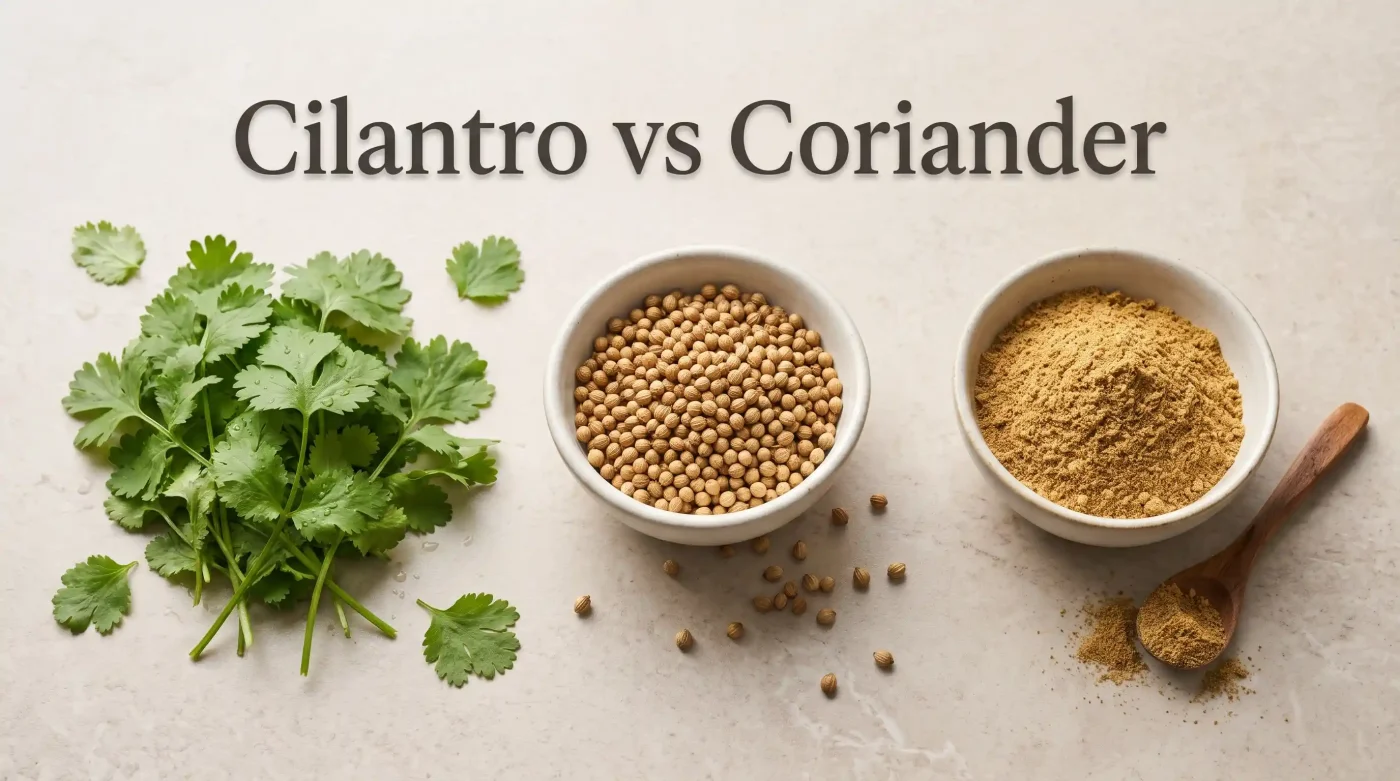
Coriander and cilantro are one of the most confusing spice-and-herb pairs. Coriander and cilantro come from the same plant, but they are not interchangeable in the kitchen. Cilantro means the fresh leaves and stems; coriander usually means the dried seeds, whole or ground.
What Are Coriander and Cilantro?
The plant is Coriandrum sativum, an annual herb in the carrot family (Apiaceae). In fact, the “seeds” are really tiny dried fruits, each made of two halves.
| Cilantro (leaves) | Coriander (seeds) | |
| Form | Soft, fresh green leaves and stems | Hard, round, light brown seeds, whole or ground |
| Flavor | Sharp, green and bright; some people taste soap | Warm and mild, with a citrus-like note |
| Main aroma compounds | Aldehydes | Linalool |
| How it is used | Soups, salads, dressings, chutneys, salsas | Curry powder, pickling spices, sausages, meat, fish and baked goods |
| Coriander leaves | Fresh leaves and stems | Can mean the leaves, seeds, or whole plant |
| Shelf life | Perishable; wilts fast | Dry spice; stores well in a sealed container |
| When to add | At the end, or raw | Early, toasted or cooked in oil |
This naming split explains why coriander and cilantro taste, look, and cook so differently, even though they grow on the same stem.
What Is Cilantro Called Around the World?
“Cilantro” is the Spanish word for the plant. It most likely entered American English through Mexican cooking, which uses the fresh leaves a lot, while Americans kept “coriander” for the dried seed. Most other English-speaking countries use “coriander” for the whole plant.
| Where | Fresh leaves | Seeds |
| United States | Cilantro | Coriander |
| UK, Ireland, Australia, New Zealand | Coriander or fresh coriander | Coriander seed |
| India (Hindi) | Dhania or hara dhania | Dhania seeds |
| Spanish-speaking countries | Cilantro | Semillas de cilantro |
| Other English name | Chinese parsley | N/A |
Which One Does Your Recipe Mean?
Because of these naming differences, a UK or Indian recipe that says “coriander” often means the leaves. Check how it is measured:
| If the recipe says… | Buy this |
| “a bunch”, “a handful”, “chopped”, “fresh coriander”, “to garnish”, “hara dhania” | Fresh cilantro |
| “teaspoon”, “ground”, “seeds”, “toasted”, “crushed”, “dhania powder” | Whole or ground coriander seed |
| Both seed and leaves | Both: seed for cooking, leaves for finishing |
Simple rule to follow: If the recipe measures it by the bunch, handful, or “to garnish,” it usually means fresh leaves. If it measures it by teaspoon or tablespoon, or says “ground,” “seeds,” or “toasted,” it usually means coriander seed.
How to Use Cilantro and Coriander?
Fresh cilantro is the leafy herb. It goes into soups, curry, salads, dressings, chutneys and salsas. Add it at the end of cooking or use it raw.
Cilantro stems are edible too. The tender upper stems carry the same flavor as the leaves, so chop them in with the leaves and trim only the thick, woody ends. In Thai cooking, even the roots go into curry pastes.
Coriander seed loves heat. Toast whole seeds in a dry pan and grind them fresh, or use ground coriander in curries, stews, marinades, pickles and baked goods. Most of the world’s coriander is used in curry powder, where it typically makes up 25 to 40% of the blend (Diederichsen, 1996).
Herb To Body offers Coriander Seed Whole, Coriander Seed Powder and Cilantro Leaf C/S, a dried cut-and-sifted cilantro leaf. To go deeper into the plant itself, read our coriander plant profile.

Whole vs. Ground Coriander
- Whole seed: Keeps its aroma longer. Toast and grind it just before cooking, or use it whole in pickling brines and rubs.
- Ground coriander: Ready to use, but it loses aroma faster once opened. Buy smaller amounts and keep it sealed, away from heat and light.
Dried Cilantro Leaf
Dried cilantro leaf is milder than fresh. Stir it into soups, stews, rice and sauces while they cook rather than using it as a raw garnish.
Can You Substitute Cilantro for Coriander?
If a recipe needs fresh cilantro and you only have coriander seed, don’t swap them directly. The flavors are too different, and a one-to-one substitution will change the taste and flavor of the dish.
- If a recipe needs fresh cilantro and you only have seed, skip the seed. Use another fresh herb instead, or simply leave it out.
- If a recipe needs coriander seed and you only have fresh cilantro, the leaf will not give you that warm, earthy spice note.
- If a recipe lists both, it wants both. Many curries use ground seed while cooking and fresh leaves on top.
Need a detailed guide? Our coriander substitutes for seed and fresh leaves guide covers the pantry swaps that work, and the ones that don’t.
Why Do They Taste So Different?
The fresh green plant gets its smell from a group of compounds called aldehydes. Two of the main ones are (E)-2-decenal and (E)-2-dodecenal. Scientists describe their smell as “soapy, fatty.” As the seeds ripen, these aldehydes fade away. (Source: Receptor genes influences cilantro preference)
The ripe seed takes on a new main aroma compound called linalool. In a study of 237 coriander seed samples, linalool made up about 68% of the seed’s essential oil on average (Diederichsen, 1996, Table 3). Linalool is only found in the oil canals inside the seed, not in the leaves.
Why Does Cilantro Taste Like Soap to Some People?
A 2012 study found that a genetic difference was linked to cilantro tasting soapy. Women and people of European ancestry were more likely to report it. Genetics influence whether someone notices the soapy flavor, but they do not fully explain individual differences in cilantro preference. Getting used to its flavor may also help some people enjoy it over time. Coriander seed usually does not taste soapy. (Source: Eriksson N, Wu S, Do CB, et al. A genetic variant)
Familiarity seems to matter. In a separate 2012 study of young adults in Toronto, dislike of cilantro varied widely by background:
| Group | Disliked cilantro |
| East Asian | 21% |
| Caucasian | 17% |
| African descent | 14% |
| South Asian | 7% |
| Hispanic | 4% |
| Middle Eastern | 3% |
The groups with the lowest dislike come from cuisines that use cilantro often.
How Does Cilantro Turn Into Coriander?
If you grow cilantro, you can watch one ingredient become the other:
- Leaf stage: the plant grows soft, flat leaves. This is the cilantro you harvest.
- Bolting: in hot weather and long days, the plant sends up a tall flower stalk. New leaves turn thin and feathery, and their flavor fades and can turn bitter.
- Flowering: small white to pale pink flowers form in umbrella-shaped clusters.
- Green seed: the flowers turn into round green seeds.
- Dry seed: the seeds turn light brown and dry on the plant. This is coriander.
To keep harvesting leaves longer, pick often and pinch off flower stalks early. To collect coriander, let the plant flower and dry out. Learn more in our coriander plant profile.
Coriander vs. Cilantro: Key Differences
- Form: fresh leaf and stem vs. dried seed, whole or ground.
- Flavor: green and bright vs. warm and mild.
- Culinary role: finishing herb vs. cooking spice.
- Shelf life: days vs. a year or more for whole seed in a sealed container.
Culantro vs. Cilantro: Not the Same Plant
Culantro is a different plant. Its botanical name is Eryngium foetidum. It is in the same plant family as cilantro (Apiaceae), but it is a separate species. It has long, tough leaves with saw-toothed edges, which is why some people call it “saw leaf herb.” In Puerto Rico, it is called recao. It is grown widely in the Caribbean and Central America.
The leaves smell a lot like cilantro but have a stronger flavor. So if a Caribbean recipe calls for culantro or recao, cilantro is not the same ingredient, even though the names sound alike.
Parsley vs. Cilantro: How to Tell Them Apart?
Parsley (Petroselinum crispum) is also in the carrot family, Apiaceae, but it is a different plant from cilantro. Flat-leaf parsley and cilantro can be easy to confuse on the shelf. The quickest test is to crush a leaf and smell it. Cilantro has a strong, distinctive smell that parsley does not.
Is Coriander Safe to Eat?
For most people, yes. Coriander is “generally recognized as safe” (GRAS) as a food by the U.S. Food and Drug Administration.
Still, some people should take care:
- Allergies: Allergic reactions to coriander have been reported. People with allergies to celery, carrot, or related plants may be more likely to react. If you have a known allergy, check with an allergist before using concentrated coriander products.
- Concentrated forms: Using coriander as a kitchen herb is not the same as taking a strong extract or oil.
The Bottom Line
Choose based on your recipe, not the name. Use fresh cilantro leaves to finish a dish, on the other hand use coriander seed to build flavor while it cooks. If cilantro tastes like soap to you, try coriander seed or you may find 12 Best Cilantro and Coriander Substitutes to Perfect Your Cooking.
References
- Eriksson N, Wu S, Do CB, et al. A genetic variant near olfactory receptor genes influences cilantro preference. Flavour. 2012;1:22
- UF/IFAS Gardening Solutions. “Culantro.”
- University of Wisconsin-Madison Extension. “Parsley.”
- Drugs and Lactation Database (LactMed). Coriander. National Library of Medicine (US). NBK501792
- Stäger J, Wüthrich B, Johansson SG. Spice allergy in celery-sensitive patients. Allergy. 1991;46(6):475-478. PMID 1957997
- Mauer L, El-Sohemy A. Prevalence of cilantro (Coriandrum sativum) disliking among different ethnocultural groups. Flavour. 2012;1:8.
Frequently Asked Questions (FAQ)
Cilantro means the fresh leaf and stem, while coriander means the dried seed.
Warm, nutty and lightly citrusy, especially once toasted.
In Spanish, cilantro refers to the fresh coriander leaves; semillas de cilantro means coriander seeds.
In cooked dishes like soups, stews and rice, yes, though the flavor is milder. For salsa or garnish, fresh works better.
Certain aldehydes in the leaves can smell soapy. Genetics play a part, but they are not the only factor.
No. Culantro (Eryngium foetidum) is a different plant in the same family. It has long, saw-toothed leaves and a stronger flavor.
Genetics, how strongly someone smells the leaf’s aldehydes, and how familiar they are with the herb all play a part.
Cilantro is good for most people when eaten in normal food amounts. It is very low in calories and provides vitamin K, vitamin A, vitamin C, folate, potassium, and plant compounds with antioxidant activity.
Disclaimer: *These statements have not been evaluated by the Food and Drug Administration. This product is not intended to diagnose, treat, cure or prevent any disease.

Cilantro vs Coriander: Differences, Flavor & Uses
Coriander and cilantro are one of the most confusing spice-and-herb pairs. Coriander and cilantro come...
Nov
Fenugreek Tea: How to Make It, What It Tastes Like, and What to Know
Fenugreek is a popular herb often used in traditional home remedies for hair care, skin...
Nov
10 Winter Herbs and Spices for Tea and How to Brew Each One
Fall is slowly turning into winter. Days get shorter, and nights get colder. Leaves drop,...
Oct
Halloween Food Ideas: Easy Herbs and Spices for Party Recipes
Halloween is more than costumes, candy, and spooky decorations. It is a reason to gather...
Oct

Columbus Day 2026: History, Plants of the Columbian Exchange
Many foods and herbs we use today including chili peppers, cacao, vanilla, tomatoes, and potatoes,...
Oct

Vitamin C Powder: Forms, Dosage, Safety, and How to Choose
Vitamin C powder is a dissolvable supplement that is usually made with ascorbic acid or...
Oct

Goldenseal Root: Uses, Dosage, Safety & How to Buy It
What Is Goldenseal Root? Goldenseal root is a bitter yellow herb with a long history...
Oct
Andrographis Paniculata: Benefits, Herb Profile, Uses, Dosage & Safety
Andrographis paniculata is a bitter medicinal herb from the Acanthaceae family, often called “King of...
Sep

Patriot Day: History, Facts, and 9/11 Remembrance
Patriot Day is a day of remembrance. It is held every year on September 11th...
Sep
Olive Leaf: Benefits, Active Compounds, and How to Use It
We all use or have heard about olive oil. But did you know that the...
Sep
Labor Day Sale: Fresh Fall Botanicals
Update: The Herb To Body Labor Day 2026 sale ended on Monday, September 7, 2026,...
Sep
Astragalus Root: Benefits, Uses, Dosage & Safety
Astragalus root, also known as huang qi, comes from a plant in the pea family...
Aug
What Is Echinacea: Benefits, Active Compounds, Types, Uses and Who Should Avoid It?
When the cold season arrives, many people add a traditional botanical such as Echinacea to...
Aug

Elderberry (Sambucus nigra): What It’s Used For, Potential Benefits & Safety
Every autumn, the same scene plays out – someone at home starts sniffling. Through the...
Aug
Immune Supporting Herbs: Forms, Uses & Safety Guide
What is an Immune Support Herb? An immune-support herb is a plant traditionally used for...
Aug

Back to School Wellness: A Routine for the Whole School Year
The first bell of the school year changes a household’s routine overnight. Bedtimes shift earlier,...
Aug
Herbs for Women: Traditional Uses, Research Notes and Safety
Many women wellness seekers search for simple herbs to add to a daily routine. Some...
1 Comment
Aug

Oat Straw Tea: Benefits, Uses & How to Brew and Use Perfectly?
What Is Oat Straw Tea? Oat straw tea is a mild herbal tea made from...
Jul
Shikakai Powder: Benefits, Active Compounds, Uses and Safety
Long before bottled shampoo existed, people in South Asia reached for a dried legume pod...
Jul

Mugwort Tea: Benefits, How to Make It, Taste & Safety Guide
Mugwort tea (Artemisia vulgaris), also known as the “Mother of Herbs,” holds a storied place...
Jul

Wormwood Herb: Benefits, Side Effects, Uses, Compounds & More
Wormwood (Artemisia absinthium) is one of the most famous and intensely bitter herbs in traditional...
Jul

Wheatgrass Juice Powder: Benefits, Nutrients, Uses, Taste Comparison & Buying Guide
In a perfect world, we’d all eat fresh greens every single day. But reality hits...
Jul
Yerba Mate: What Is It, Benefits, Caffeine Amount, and How to Make It
Yerba mate is a traditional caffeinated beverage from South America made from the dried leaves...
Jul

Alligator Pepper: Flavor, Uses, Botanical Profile, Substitute and Buying Tips
If you heard the name “alligator pepper,” what comes to mind? Is it the same...
Jul
Green Black Walnut Hull & Extract (Juglans nigra): Benefits, Uses & How It Differs
When you’re looking for black walnut hull, you quickly notice two very different products. One...
Jul