


Astragalus, Herbs, Immune Supporting Herbs
Astragalus Root: Benefits, Uses, Dosage & Safety
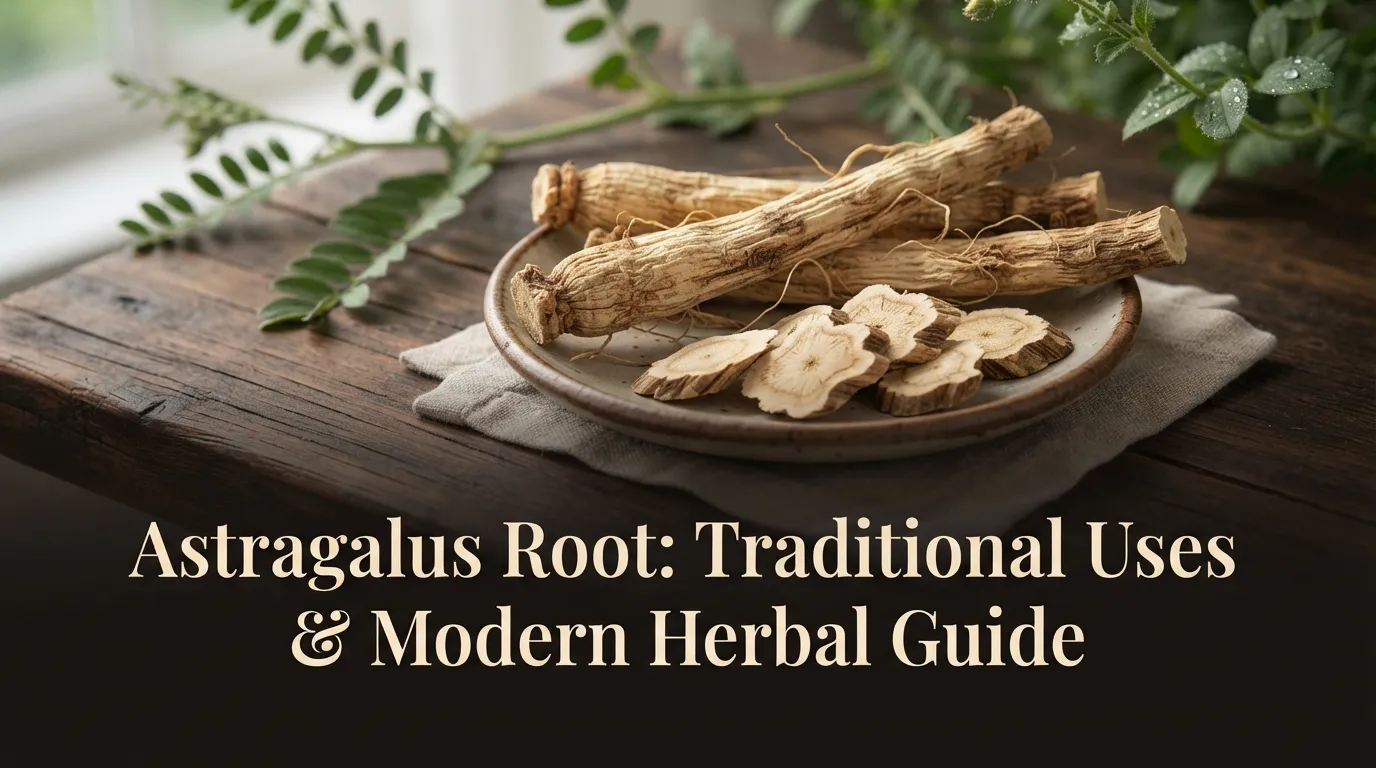
Astragalus root, also known as huang qi, comes from a plant in the pea family and has a long history of use in Traditional Chinese Medicine. Its main studied compounds include astragalus polysaccharides, astragaloside IV, and formononetin.
Research is exploring how these compounds interact with the body, but many findings come from laboratory or early-stage studies – not proven health benefits. Below you’ll find what astragalus root is, what current research suggests, how to prepare it, and who should avoid it.
Key Highlights
- Botanical name: Astragalus mongholicus (also listed in older literature as Astragalus membranaceus).
- Plant part: Root.
- Plant family: Fabaceae – the pea and bean family.
- Taste: Mild, fibrous, slightly sweet.
- Traditional use: A daily tonic taken to support the body’s natural defenses, steady energy, and kidney vitality.*
What Is Astragalus Root?
Astragalus root is a woody tonic root. In TCM, it is called Huang Qi, pronounced hwang chee.
Most herbs get reached for when you already feel unwell. This one works the other way. Herbalists take it steadily through the cold months, so the support builds before it is needed.
What Is Astragalus Root Used For?
People use it as a daily tonic. In TCM it is traditionally taken to:
- Support the body’s natural defenses*
- Support steady energy when you feel run down*
- Support normal kidney function and glucose metabolism already within a normal range, as part of a wider plan*
Research is early and mixed. Most human studies are small.
* These statements have not been evaluated by the Food and Drug Administration. This product is not intended to diagnose, treat, cure, or prevent any disease.
What Does Astragalus Do To Your Body?
In TCM, astragalus is said to support Wei Qi – “defensive qi,” the body’s outer protective layer. That is traditional framing, not biochemistry. Still, it maps closely onto where modern research has looked.
Here is the chain, as far as laboratory work has traced it:
- Astragalus polysaccharides (APS) are large carbohydrates. They absorb poorly and appear to act mainly at the gut lining.*
- In cell and animal studies, APS have been examined as signaling molecules at immune-cell receptors such as TLR4.*
- That signaling has been linked, in preclinical models only, to macrophage and natural killer (NK) cell activity.*
Two honest caveats. Studied in cells is not the same as shown in people. And an immune-signaling mechanism is exactly why the avoid list below excludes autoimmune conditions – the possible benefit and the possible risk run through the same pathway.
Active Compounds in Astragalus Root
Three families of plant compounds do most of the work.
| Compound family | Common names | What research has looked at |
| Polysaccharides | Astragalus polysaccharides (APS) | May help support normal immune-cell signaling |
| Saponins | Astragaloside IV, cycloastragenol | May act as antioxidants that help protect healthy cells |
| Flavonoids | Formononetin, quercetin | May help protect cells from everyday oxidative stress |
According to the Memorial Sloan Kettering herb monograph, astragalus compounds have been studied for effects on immune signaling, including TLR4 pathways and natural killer cell activity. Astragaloside IV has also been researched in laboratory and animal models for effects on cell signaling pathways such as notch1/hes1 (MSKCC).
Cycloastragenol, Telomeres and TA-65
Cycloastragenol is a plant compound associated with astragalus research. Scientists have studied it for its possible effect on telomerase, an enzyme involved in maintaining telomeres – the protective structures at the ends of chromosomes. However, research on telomere length does not prove that astragalus or cycloastragenol can slow aging, extend lifespan, or prevent disease. (Source: PMC).
Benefits of Astragalus: What Research Suggests
Here are the associated benefits found regarding in reserach
May Support Normal Immune Function*
Astragalus polysaccharides may support normal white blood cell activity.* For example, a 2023 review of 19 studies pooled 1,094 participants over 4 to 24 weeks. Reviewers reported improvements in immune markers across those studies, though study quality varied (NCCIH).
May Support Normal Kidney Function*
Kidney function is the most-studied area for this root. Early clinical reviews suggest astragalus extracts may help support normal kidney filtration and healthy protein balance in urine.*
A 2023 meta-analysis of astragalus formulas pooled 3,423 participants, and a 2014 Cochrane review assessed astragalus formulas in clinical settings (Cochrane, DOI 10.1002/14651858.CD008369.pub2).
May Support Glucose Metabolism Already Within a Normal Range*
Early research suggests astragalus polysaccharides may help support blood sugar already within a normal range, alongside a balanced diet.*
A 2024 review pooling 953 adults reported greater changes in blood glucose markers when astragalus was used alongside standard care. NCCIH adds the caveat that most of those studies were low quality (NCCIH).
If you take any medication that affects blood glucose, talk to your prescriber before starting. Additive effects are not automatically a good thing.
Heart and Circulation*
Astragaloside IV has been reviewed for cardiovascular pharmacology in the peer-reviewed literature (Advances in Pharmacology, 2020, DOI 10.1016/bs.apha.2019.08.002). Much of that work sits at cell and animal level. Human outcome data is thin.
* These statements have not been evaluated by the Food and Drug Administration. This product is not intended to diagnose, treat, cure, or prevent any disease.
Astragalus and Skin, Lungs, and for Adults
A few areas come up often. Here is where the research actually stands.
Skin: Research on astragalus and skin is still developing. Studies have explored topical astragalus extracts for skin hydration, the skin’s normal inflammatory response, wound repair, and visible aging. There isn’t enough evidence to say that oral astragalus root does anything for skin. (Source: PMC12029721)
Lungs: Astragalus is traditionally associated with the “Lung” system in Traditional Chinese Medicine. That is a traditional concept, not a modern medical claim.
Adults of any gender: Current research shows no distinct effects or dose recommendations for astragalus in women versus men. It contains formononetin, which may interact with estrogen receptors – one reason the caution list below includes hormone-sensitive conditions. (Source: PMC NCBI)
Astragalus Compared With Other Tonic Roots

People often confuse astragalus with several other botanicals. Here is how they line up.
| Herb | Plant part | Main focus | Usual timing |
| Astragalus (A. mongholicus) | Root | Defensive qi, immune support* | Daily, cooler months |
| Ashwagandha (Withania somnifera) | Root | Calm and restful sleep support* | Daily, often evening |
| Echinacea (Echinacea purpurea) | Leaf and root | Short-term support at symptom onset* | 7 to 10 days only |
| Rhodiola (Rhodiola rosea) | Root | Mental focus, daytime energy* | Morning or early afternoon |
| Panax ginseng | Root | Stimulating energy and stamina* | Morning, often cycled |
| American ginseng (P. quinquefolius) | Root | Cooling counterpart to Panax | Daily, gentler |
| Milk thistle (Silybum marianum) | Seed | Liver support*, a different job | Daily, with food |
| Astaxanthin | Algae carotenoid, not an herb | Antioxidant support* | Daily, with fat |
Astragalus Root Vs Astragalus Extract
“Root” means the dried, sliced plant material. “Extract” means constituents pulled out with water or ethanol, concentrated, then sold as a liquid or dried powder.
| What you are buying | What it means | Best for |
| Whole root (C/S) | Dried sliced root, nothing removed | Decoctions, broths, formulating from scratch |
| Root powder | The same root, milled fine | Blending, capsuling, bulk formulation, tea |
| Ratio extract (e.g. 10:1) | 10 kg of root reduced to 1 kg – a concentration claim, not a potency guarantee | Convenience, smaller servings |
| Standardised extract | Assayed to a stated level of a marker compound, usually astragaloside IV | Anyone who needs a documented constituent level |
How to Use Astragalus Root
The root comes as cut-and-sifted slices, fine powder, capsules, tinctures, and liquid extracts. The form changes the method more than it changes the herb.
Astragalus Tea
Most people like to drink astragalus tea. A tea is steeped – hot water poured over plant material for a few minutes. That works for leaves and flowers. Astragalus is a woody root, and a steep barely touches it. What you want is a decoction: a simmer. Same ingredients, same cup, different method.
Astragalus Root Decoction Recipe
You need:
- 9–15 g dried sliced root – roughly 3 to 5 tablespoons
- 3 cups (about 700 ml) cold water
- A non-reactive pot with a lid
Method
- Put the root and cold water in the pot together. A cold start draws more from the root than boiling water does.
- Bring to a bare boil, then drop the heat until the surface barely moves.
- Cover and simmer 20 to 30 minutes. The liquid should reduce by about a third.
- Strain. You will have roughly two cups of pale gold liquid.
The spent slices take a second simmer, though the result is weaker.
The taste is mild and slightly sweet, with a faint beany background. Nothing about it is difficult. A slice of fresh ginger or a cinnamon stick suits the cooler months.
Making the Soup
This is how the root is most often used at home in China, and it is the easiest way to keep it in a routine. Drop three or four slices into chicken or vegetable broth at the start of a long simmer, then fish them out before serving. They are not meant to be eaten. Our astragalus root C/S is cut for exactly this.
Powder, Capsules and Tinctures
Powder stirs into broth, congee, or a smoothie. It does not dissolve cleanly, so expect a little texture. Our astragalus root powder suits formulators who blend their own.
Capsules trade the ritual for convenience. Check the label for the botanical name and the extract ratio.
Tinctures and liquid extracts work when travel or timing rules out a simmer. Ethanol pulls the saponins well.
What Astragalus Data Suggests
Clinical trial data are lacking to guide dosing recommendations. Traditional practice uses roughly 9–15 g of dried sliced root in a daily decoction, as in the recipe below. The highest amount reported in the literature is up to 60 g per day for up to four months, recorded without adverse effects and not a recommended amount. None of this is dosing advice – always follow your product label.
Source: (NCCIH)
Timing: When to Take Astragalus and for How Long
There is no established onset time or scientifically proven “best” time of day. Human studies have generally lasted weeks, so astragalus should not be viewed as a same-day fix.
Many people take it with food, often earlier in the day. Follow the product label and stop if it causes unwanted effects.
Daily Use and Duration
Astragalus may be used daily by some healthy adults, but long-term safety is uncertain. NCCIH reports that amounts up to 60 grams per day have been used for up to four months without reported adverse effects. This does not establish a recommended amount or prove safety for everyone.
There is insufficient evidence to recommend continuous use beyond 4 months or to specify a cycling schedule. Speak with a healthcare professional before using astragalus if you take medication, have an immune or hormone-sensitive condition, or are preparing for surgery.
Which Astragalus Are You Actually Buying?
The name covers a very large group of plants. The Astragalus genus includes 2,000 to 3,000 species. Yet only one is the root sold as huang qi. Ours is Astragalus mongholicus.
This matters because some North American astragalus species are commonly known as locoweed. Locoweed is poisonous to grazing animals, so it should never be used as an herb. Notably, a few astragalus species also take up high levels of selenium from the soil.
Safety, Side Effects and Drug Interactions
Astragalus is generally well tolerated by healthy adults, but some people should avoid it. Possible side effects include stomach upset, loose stools, nausea, rash, itching, or allergy-like symptoms. Stop using it and seek medical advice for swelling or breathing difficulty. (Source: Clinical and Research Information on Astragalus)
Avoid or discuss astragalus with a healthcare professional if you:
- Have an autoimmune condition
- Are pregnant or breastfeeding
- Have a hormone-sensitive condition
- Have a legume allergy
- Are preparing for surgery or an organ transplant
Astragalus may interact with immunosuppressants and with medications for blood glucose, blood pressure, blood clotting, and lithium, as well as some oncology medicines. It is not a blood thinner. Talk to your prescriber before combining astragalus with any medication.
Astragalus for Children
No paediatric amount is established, and children have not been studied in the trial literature. Traditional practice in China does include a few slices in a shared family soup pot, and that culinary use differs in kind from giving a child a supplement serving.
For safety, do not give astragalus to a child as a supplement unless a paediatrician or qualified practitioner directs it. Absence of harm data is not evidence of safety.
Astragalus for Pets
Astragalus does appear in veterinary herbal practice. However, there is a specific reason for extra care around animals.
The Astragalus genus includes locoweed species that are poisonous to livestock and pets. Species identity matters for people; it matters more when someone is dosing a 10 kg animal.
- Do not give astragalus to a pet on your own judgment or on an amount found online.
- Work with a veterinarian, ideally one who practices veterinary herbal medicine.
- If a vet directs it, use a product with the botanical name on the batch and a certificate of analysis.
- The autoimmune and immunosuppressant cautions above apply to animals on those medications too.
Why Buy Astragalus Root From Herb To Body?
We supply Astragalus mongholicus root in bulk sizes.
- Single ingredient: sliced root and nothing else – no fillers, no flow agents, no blends hiding ratios.
- Botanical name on every batch, so you know the species in the bag.
- Packed in the USA.
- Bulk wholesale pricing, so you control freshness.
- Two cuts, two jobs. Cut-and-sifted for decoctions and broths; powder for blending and formulation.
Where to Start?
If you want the ritual and the flexibility, take the astragalus root C/S. Namely, it handles decoctions, broths and long simmers. The astragalus slices are cut evenly enough to extract predictably at 20 minutes. If you blend your own formulas, the astragalus root powder comes in 4 oz and 1 lb.
Conclusion
Astragalus is a traditional herb with limited but growing research behind it. It is not suitable for everyone and may interact with medicines or existing health conditions. Choose products carefully and consult a healthcare professional before regular use, especially if you take prescription medication, are pregnant, or have an autoimmune or hormone-sensitive condition.
Sources & References
- National Center for Complementary and Integrative Health (NCCIH). Astragalus: Usefulness and Safety. U.S. National Institutes of Health.
- Memorial Sloan Kettering Cancer Center. Astragalus – Integrative Medicine Herb Monograph.
- Astragalus (plant) – Wikipedia
- Zhang X, Qu X, Zou Y. The effect of astragalus on humoral and cellular immune response: a systematic review and meta-analysis of human studies. Complementary Medicine Research. 2023;30(6):535–543. PMID: 37952511
- Hong K-F, Liu P-Y, Zhang W, et al. The efficacy and safety of astragalus: a systematic review and meta-analysis. Journal of Integrative and Complementary Medicine. 2024;30(1):11–24. PMID: 37433206
- Wang D, Wang L, Zhang M, et al. Astragalus membranaceus formula for moderate-high risk idiopathic membranous nephropathy: a meta-analysis. Medicine (Baltimore). 2023;102(9):e32918. PMID: 36862887
- Potential benefits of incorporating Astragalus membranaceus into the diet – Science Direct
Frequently Asked Questions (FAQ)
Astragalus is often called an adaptogen, though that word comes from herbalism rather than any regulatory category. In Traditional Chinese Medicine it is classified as a qi tonic – an herb taken steadily over time rather than at the first sign of feeling unwell.
Simmer 1 teaspoon in 8 ounces of hot water for 15-20 minutes. Strain before drinking.
The evidence is early and mixed. The most-studied area is kidney research, where meta-analyses have pooled thousands of participants – but those trials ran in clinical populations under medical supervision, so they do not describe what a healthy adult should expect from a daily tonic. Immune and blood-sugar research exists, and reviewers consistently rate those studies small and need more research.*
No research establishes a best time. Traditional use puts astragalus with food, usually earlier in the day. A warm decoction suits a morning or midday routine, and some people find tonic herbs taken late in the evening leave them feeling less settled at bedtime.
Astragalus root is the dried root used in Traditional Chinese Medicine as a qi tonic associated with defensive energy. Modern research has examined its compounds in relation to normal immune function, normal kidney function, and blood sugar already within a normal range, though most studies are small.*
For using Astragalus membranaceus
- Daily Use: Mix 1 teaspoon (approx. 3g) into smoothies, juice, or water.
- Cooking: Add 1 teaspoon to soups, stews, or bone broths and simmer to extract the sweet, earthy flavor.
- Tea: Simmer 1 teaspoon in 8 ounces of hot water for 15-20 minutes. Strain before drinking.
They are the same herb. Huang qi is the Chinese name for the dried root of Astragalus mongholicus. You may also see it labelled milk vetch, astragali radix, Astragalus membranaceus, or Astragalus propinquus.
No clinical data establish an onset time. Astragalus is traditionally used as a build-over-time tonic rather than a herb with a same-day effect, and the human studies that exist ran for weeks to months. Most people will not feel a distinct effect.*
Disclaimer: *These statements have not been evaluated by the Food and Drug Administration. This product is not intended to diagnose, treat, cure or prevent any disease.

Columbus Day 2026: History, Plants of the Columbian Exchange
Many foods and herbs we use today including chili peppers, cacao, vanilla, tomatoes, and potatoes,...
Oct

Vitamin C Powder: Forms, Dosage, Safety, and How to Choose
Vitamin C powder is a dissolvable supplement that is usually made with ascorbic acid or...
Oct

Goldenseal Root: Uses, Dosage, Safety & How to Buy It
What Is Goldenseal Root? Goldenseal root is a bitter yellow herb with a long history...
Oct
Andrographis Paniculata: Benefits, Herb Profile, Uses, Dosage & Safety
Andrographis paniculata is a bitter medicinal herb from the Acanthaceae family, often called “King of...
Sep

Patriot Day: History, Facts, and 9/11 Remembrance
Patriot Day is a day of remembrance. It is held every year on September 11th...
Sep

Olive Leaf: Benefits, Active Compounds, and How to Use It
We all use or have heard about olive oil. But did you know that the...
Sep
Labor Day Sale: Fresh Fall Botanicals
Update: The Herb To Body Labor Day 2026 sale ended on Monday, September 7, 2026,...
Sep
Astragalus Root: Benefits, Uses, Dosage & Safety
Astragalus root, also known as huang qi, comes from a plant in the pea family...
Aug
What Is Echinacea: Benefits, Active Compounds, Types, Uses and Who Should Avoid It?
When the cold season arrives, many people add a traditional botanical such as Echinacea to...
Aug

Elderberry (Sambucus nigra): What It’s Used For, Potential Benefits & Safety
Every autumn, the same scene plays out – someone at home starts sniffling. Through the...
Aug
Immune Supporting Herbs: Forms, Uses & Safety Guide
What is an Immune Support Herb? An immune-support herb is a plant traditionally used for...
Aug

Back to School Wellness: A Routine for the Whole School Year
The first bell of the school year changes a household’s routine overnight. Bedtimes shift earlier,...
Aug
Herbs for Women: Traditional Uses, Research Notes and Safety
Many women wellness seekers search for simple herbs to add to a daily routine. Some...
1 Comment
Aug
Oat Straw Tea: Benefits, Uses & How to Brew and Use Perfectly?
What Is Oat Straw Tea? Oat straw tea is a mild herbal tea made from...
Jul
Shikakai Powder: Benefits, Active Compounds, Uses and Safety
Long before bottled shampoo existed, people in South Asia reached for a dried legume pod...
Jul

Mugwort Tea: Benefits, Brewing, Flavor & the Safety Concern No One’s Telling You
Mugwort tea (Artemisia vulgaris), also known as the “Mother of Herbs,” holds a storied place...
Jul
Wormwood Herb: Benefits, Side Effects, Uses, Compounds & More
Wormwood (Artemisia absinthium) is one of the most famous and intensely bitter herbs in traditional...
Jul

Wheatgrass Juice Powder: Benefits, Nutrients, Uses, Taste Comparison & Buying Guide
In a perfect world, we’d all eat fresh greens every single day. But reality hits...
Jul
Yerba Mate: What Is It, Benefits, Caffeine Amount, and How to Make It
Yerba mate is a traditional caffeinated beverage from South America made from the dried leaves...
Jul

Alligator Pepper: Flavor, Uses, Botanical Profile, Substitute and Buying Tips
If you heard the name “alligator pepper,” what comes to mind? Is it the same...
Jul

Green Black Walnut Hull & Extract (Juglans nigra): Benefits, Uses & How It Differs
When you’re looking for black walnut hull, you quickly notice two very different products. One...
Jul

Fourth of July 2026: History, Traditions, and a Safe, Fun Day
The Fourth of July is easy to picture. The grill is going. Music is playing....
Jun

When Is Juneteenth 2026? Meaning, History, Colors & Herbal Deals
Many people know Juneteenth is a holiday, but they don’t know what to do. They...
Jun
Tongkat Ali Honey: Benefits, Taste, Uses & How to Take
Tongkat ali honey is honey mixed with tongkat ali root (Eurycoma longifolia, also called longjack)....
Jun

Best Father’s Day Gifts 2026 for a Health-Minded Dad
Most dads rarely ask for anything for themselves. They say “I’m fine” while rubbing a...
Jun
Black Seed (Nigella sativa): Compounds, Uses & Safety
Black seed is a versatile herb available year-round. It can be used in cooking, added...
Jun

Shilajit: What It Is, How It Works, and How to Choose the Right Form?
Shilajit is a natural mineral resin. It forms in high-altitude mountain ranges, mainly the Himalayas,...
Jun

Prekese (Aidan Fruit): Benefits, Active Compounds, Uses & Safety Guide
Prekese (Tetrapleura tetraptera) is a flowering tree in the Fabaceae (legume) family. It grows in...
May