


Haircare
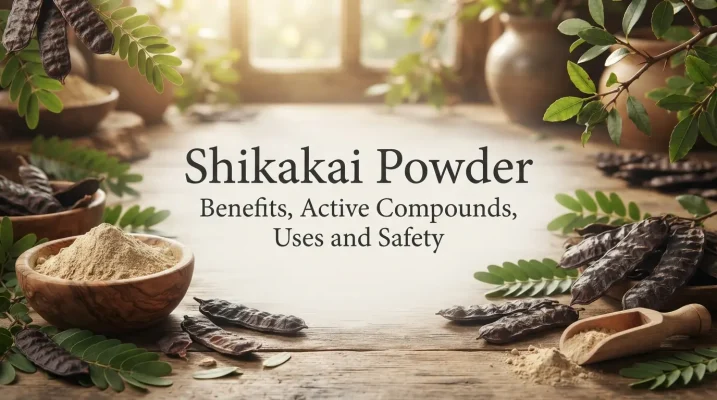
Shikakai Powder: Benefits, Active Compounds, Uses and Safety
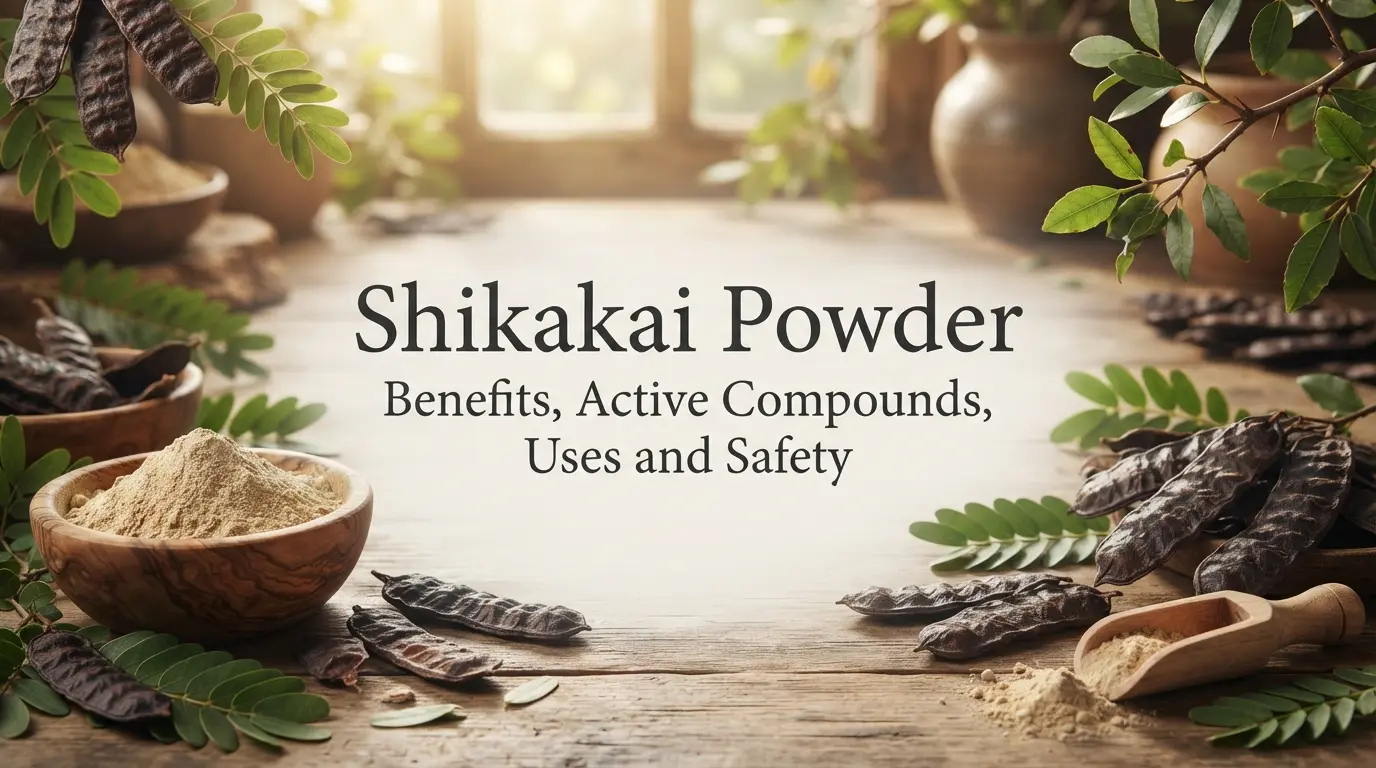
Long before bottled shampoo existed, people in South Asia reached for a dried legume pod instead. They ground it, mixed it with warm water, and washed. That pod is shikakai powder, milled from Senegalia rugata – a plant most suppliers still list under its older name, Acacia concinna.
Below you will find what the pod contains, what the research shows and does not, how to use it, and where it can go wrong. No promises about regrowth. Just the plant, its chemistry, and honest uses.
What Is Shikakai Powder?
Shikakai powder is the milled fruit pod, bark, and leaf of Senegalia rugata (Lam.) Britton & Rose, a spiny climbing shrub in the legume family, Fabaceae. The plant grows across tropical Asia and the warm plains of central and south India. Its pods dry into wrinkled, blackish, very hard cases. Ground fine, they become a pale tan powder that smells faintly sour and green.
The traditional preparation is simple. Dried plant material becomes powder, powder meets warm water, and the paste goes onto damp hair. That is the whole method, and it has not changed much in four thousand years.
Shikakai in English and Its Other Names
People often search for what shikakai in English actually means. There is no tidy single answer, which is part of the confusion.
The clearest English common name is soap pod, or soap pod wattle in Australian English. Thai research literature refers to the same plant as sompoi or som poi. The word “shikakai” itself comes from Tamil cikaikkāy – cikai meaning hair, kāy meaning unripe fruit. Literally, hair-fruit. Kannada speakers say seegekaayi; in Malayalam it is chevakka kai.
So when a US label reads “shikakai,” “soap pod,” or “Acacia concinna fruit extract,” you are looking at one species under different names.
Shikakai and Soap Nuts Are Not the Same Plant
Soap nuts come from Sapindus species. Shikakai comes from Senegalia rugata. Different genus, different plant part, different pod. Both contain saponins, which is why both foam a little and why the confusion persists. Reetha is simply the Hindi name for soap nut, and the two are traditionally blended, not substituted.
How Shikakai Compares to Reetha and Amla?
| Shikakai | Reetha (soap nut) | Amla | |
| Botanical name | Senegalia rugata | Sapindus spp. | Phyllanthus emblica |
| Plant part | Pod, bark, leaf | Fruit shell | Fruit |
| Active component | Triterpenoid saponins | Saponins (higher) | Tannins, vitamin C |
| Role in a wash | Mild cleansing, slip | Stronger cleansing, more lather | Darker rinse, conditioning tannins |
| Best use | Sulfate-sensitive hair | Added cleansing strength | Added slip and tone |
Active Compounds in Shikakai
The pod’s chemistry explains everything the powder does, including its limits. Four compound groups matter here.
Triterpenoid saponins: These are the cleansing agents. Chemical work on the highly polar saponin fraction of A. concinna pods yielded five previously undescribed prosapogenols named concinnosides A through F, alongside known glycosides including acaciasides and julibrosides (Abul Gafur et al., Chemical and Pharmaceutical Bulletin, 1997). Saponins are the same class of foaming compound found in soap nuts and yucca.
Minerals: Elemental profiling of the leaves has reported calcium at around 321 mg/100g (Ganogpichayagrai & Suksaard, Journal of Advanced Pharmaceutical Technology & Research, 2022).
Triterpenes and sterols: Hydrolysis of commercial pod extract yields lupeol, spinasterol, and acacic acid as key triterpenes, plus the sugars glucose, arabinose, and rhamnose.
Organic acids: The plant material carries oxalic, tartaric, citric, succinic, and ascorbic acid. That mix gives the wash its naturally low pH – around 4.1, close to the scalp’s own acid mantle – and it explains why the paste stings badly if it reaches your eyes.

How Saponins Actually Clean Hair?
Triterpenoid saponins are amphiphilic molecule binds water, and the other binds oil. When you wet the powder, those molecules surround sebum and product residue, lift them into suspension, and carry them off in the rinse.
Sulfates do the same job but in a harsher way. They are strong anionic surfactants, so they strip sebum nearly completely and leave the cuticle rougher. Saponins work more weakly. However, they remove less oil, foam less, and leave more of the scalp’s own lipid layer behind.
That single difference drives almost every benefit and every complaint people report about this wash.
Shikakai Powder For Hair: What Shikakai Powder May Do for Hair and Scalp?
This follows reflects compound-level research and long traditional use, not clinical proof.
It May Cleanse Without Stripping Natural Oils
Saponins are milder surfactants compared to sulfates. Which means they can effectively remove buildup while leaving some natural sebum intact. This is particularly beneficial for individuals with dry, coarse, or chemically treated hair.
However, there is a tradeoff. While milder cleansing is gentler on the hair, it may not completely remove heavy silicone or styling residue. If you frequently use strong-hold products, you might still need to use a clarifying wash from time to time to ensure thorough cleansing.
It May Help Hair Detangle More Easily
Traditional use suggests that rinsing leads to better slip and fewer tangles in their hair. The naturally low pH of the rinse may contribute to these benefits, as acidic rinses can help the hair cuticle lie flatter. It’s important to keep in mind that this is a likely explanation rather than a definite result, so consider it an expectation rather than a guarantee.
It May Support Scalp Comfort and Reduce Visible Flaking
People searching whether shikakai helps with dandruff deserve a careful answer. An infusion of the leaves has a documented history in traditional anti-flaking preparations. Separately, a small double-blinded, randomized, split-side, vehicle-controlled pilot trial tested a herbal cleanser containing Acanthus ebracteatus, Suregada multiflora, and A. concinna on patients with atopic dermatitis, measuring skin-barrier changes (Winayanuwattikun et al., Asian Pacific Journal of Allergy and Immunology, 2023).
Note the limitation honestly. That cleanser combined three botanicals, so the result cannot be attributed to this pod alone. Flaking has many causes, including fungal ones that a plant wash will not address. A dermatologist is the right call for persistent scalp trouble.
Four Myths Regarding Shikakai
There are some myth regarding shikakai powder, products, or shikakai shampoo. Lets reveal the truth
Does Shikakai Make Hair Black?
No. The powder does not dye hair. Its pale tan colour can dull very light blonde or grey hair slightly over repeated washes, similar to any plant rinse. Genuine darkening requires a dye plant such as indigo. Anyone promising black hair from this pod is overselling it.
Can Shikakai Regrow Hair?
There is no evidence that it regrows hair. Searches for shikakai powder for hair growth are extremely common, and the honest position is that a cleanser cleans. A calmer, less irritated scalp is a reasonable thing to aim for. New follicles are not.
Does Shikakai Foam Like Shampoo?
Barely, and this catches new users off guard. Saponin lather is thin, low, and short-lived compared with sulfate foam. Low lather is not weak cleansing – the two are unrelated. Nevertheless, if you equate suds with clean, this wash will feel wrong for the first few uses.
Does It Make Hair Dry?
For some people, yes. The organic acid content and the absence of any conditioning agent can leave coarse or porous hair feeling rough. Following with oil, or blending the powder with a mucilaginous herb, usually settles it. Our shikakai powder side effects guide covers who should skip this wash entirely.
Blending With Amla, Reetha and Brahmi
Shikakai is rarely used alone in traditional practice. It blends readily with amla (Phyllanthus emblica), reetha (Sapindus species), brahmi (Bacopa monnieri), and hibiscus. A common starting ratio is two parts shikakai to one part each of amla and reetha.
Amla contributes tannins and a darker rinse. Reetha adds more saponin, so it increases cleansing strength. Brahmi and hibiscus add slip. Full ratios and step-by-step blends sit in our shikakai hair wash recipe collection, and the complete method lives in how to use shikakai powder.
Other Forms You Will See
Beyond loose powder, the plant appears as pods, infused hair oils, bar soaps, and commercial bottled shampoos. Loose powder gives you the most control over strength and blending. Bottled versions trade that control for convenience, and many contain very little of the plant.
Safety, Side Effects and Who Should Skip It?
Read this section before your first wash. Most problems are avoidable.
- External use only: Herb To Body does not sell this powder for internal use. Do not eat it, do not brew it as tea, and keep it out of reach of children.
- Keep it away from your eyes: The organic acids and saponins sting sharply on contact. Rinse with plenty of cool water if it happens.
- Patch test first. Apply a small amount of diluted paste to your inner forearm and wait 24 hours. Anyone with eczema, psoriasis, or broken skin on the scalp should be especially careful.
- Expect an adjustment period. Hair can feel different for two or three washes while sebum production settles. That is normal, though it is also why some people give up early.
- Talk to your clinician first if you are pregnant, nursing, taking medication, or managing a diagnosed skin condition. Stop use if any reaction appears.
Acacia Concinna Fruit Extract has been reviewed as a cosmetic ingredient in the Cosmetic Ingredient Review panel’s assessment of Acacia-derived ingredients (International Journal of Toxicology, 2005), which is a useful reference point for topical formulators.
The Honest Takeaway
Shikakai is not a miracle, and it never claimed to be. It is a saponin-bearing legume pod that people have washed their hair with for 4,000 years because it cleans without stripping and grows nearby.
If your scalp dislikes sulfates, that is a real reason to try it. If you want foam, speed, and total residue removal, it will disappoint you. Knowing which camp you fall into matters more than any benefit list.
Herb To Body mills shikakai powder as a single-ingredient, wildcrafted botanical in a GMP-certified facility, with batch origin printed on the label.
Sources – Reference
- Natural alternatives from your garden for hair care – PMC – NIH, 2023
- Shikakai (Acacia concinna) – Uses, Remedies, Side Effects, Research – Ayurvedic Herbs, 2019
- How to Use Shikakai Powder for Hair: 7 Proven Benefits – Vedix, 2025
- 15 Shikakai Benefits For Hair & How To Use It – Nykaa, 2024
- Abul Gafur et al. Acacia concinna saponins. I. Structures of prosapogenols, concinnosides A-F – Chem Pharm Bull, 1997
- Ganogpichayagrai & Suksaard. Evaluation of proximate composition and biological activities of A. concinna leaves – J Adv Pharm Technol Res, 2022
- Cosmetic Ingredient Review. Safety Assessment of Acacia-Derived Ingredients – Int J Toxicol, 2005
Frequently Asked Questions (FAQ)
Shikakai powder is the milled pod, bark, and leaf of Senegalia rugata, a legume also listed as Acacia concinna. It contains natural saponins and has been used across South Asia as a hair-washing paste for thousands of years.
Shikakai powder is a traditional plant-based hair cleanser. Its natural saponins gently remove dirt and buildup while helping maintain the scalp’s natural oils. Mix it with water to form a paste and apply to damp hair as a wash.
It may suit hair that reacts badly to sulfates. Saponins cleanse more mildly, so more of the scalp’s natural oil stays behind. Coarse or porous hair can feel dry afterward, so many people follow with oil.
No. Soap nuts come from Sapindus species, while shikakai comes from Senegalia rugata. Both contain saponins and both foam lightly, which causes the mix-up. Traditional hair washes blend them rather than swapping one for the other.
No, it does not dye hair. The powder is pale tan and cannot darken hair the way indigo or henna does. Repeated washes may slightly dull very light blonde or grey shades, as most plant rinses can.
No. Herb To Body sells this powder for external use only, and the label carries a California Proposition 65 lead notice. Use it as a hair and scalp wash. Keep it away from food, children, and pets.
Once or twice weekly suits most people. Mix 1 to 2 tablespoons with warm water, apply to damp hair and scalp, then rinse fully. Daily use may leave coarse hair feeling dry over time.
Disclaimer: *These statements have not been evaluated by the Food and Drug Administration. This product is not intended to diagnose, treat, cure or prevent any disease.

Columbus Day 2026: History, Plants of the Columbian Exchange
Many foods and herbs we use today including chili peppers, cacao, vanilla, tomatoes, and potatoes,...
Oct

Vitamin C Powder: Forms, Dosage, Safety, and How to Choose
Vitamin C powder is a dissolvable supplement that is usually made with ascorbic acid or...
Oct

Goldenseal Root: Uses, Dosage, Safety & How to Buy It
What Is Goldenseal Root? Goldenseal root is a bitter yellow herb with a long history...
Oct
Andrographis Paniculata: Benefits, Herb Profile, Uses, Dosage & Safety
Andrographis paniculata is a bitter medicinal herb from the Acanthaceae family, often called “King of...
Sep

Patriot Day: History, Facts, and 9/11 Remembrance
Patriot Day is a day of remembrance. It is held every year on September 11th...
Sep

Olive Leaf: Benefits, Active Compounds, and How to Use It
We all use or have heard about olive oil. But did you know that the...
Sep
Labor Day Sale: Fresh Fall Botanicals
Update: The Herb To Body Labor Day 2026 sale ended on Monday, September 7, 2026,...
Sep
Astragalus Root: Benefits, Uses, Dosage & Safety
Astragalus root, also known as huang qi, comes from a plant in the pea family...
Aug
What Is Echinacea: Benefits, Active Compounds, Types, Uses and Who Should Avoid It?
When the cold season arrives, many people add a traditional botanical such as Echinacea to...
Aug

Elderberry (Sambucus nigra): What It’s Used For, Potential Benefits & Safety
Every autumn, the same scene plays out – someone at home starts sniffling. Through the...
Aug
Immune Supporting Herbs: Forms, Uses & Safety Guide
What is an Immune Support Herb? An immune-support herb is a plant traditionally used for...
Aug

Back to School Wellness: A Routine for the Whole School Year
The first bell of the school year changes a household’s routine overnight. Bedtimes shift earlier,...
Aug
Herbs for Women: Traditional Uses, Research Notes and Safety
Many women wellness seekers search for simple herbs to add to a daily routine. Some...
1 Comment
Aug
Oat Straw Tea: Benefits, Uses & How to Brew and Use Perfectly?
What Is Oat Straw Tea? Oat straw tea is a mild herbal tea made from...
Jul
Shikakai Powder: Benefits, Active Compounds, Uses and Safety
Long before bottled shampoo existed, people in South Asia reached for a dried legume pod...
Jul

Mugwort Tea: Benefits, Brewing, Flavor & the Safety Concern No One’s Telling You
Mugwort tea (Artemisia vulgaris), also known as the “Mother of Herbs,” holds a storied place...
Jul

Wormwood Herb: Benefits, Side Effects, Uses, Compounds & More
Wormwood (Artemisia absinthium) is one of the most famous and intensely bitter herbs in traditional...
Jul

Wheatgrass Juice Powder: Benefits, Nutrients, Uses, Taste Comparison & Buying Guide
In a perfect world, we’d all eat fresh greens every single day. But reality hits...
Jul