

Tongkat Ali

Herb and Plant Profile of
Tongkat Ali
plant overview
Tongkat Ali (Eurycoma longifolia), also called Long Jack or Malaysian ginseng, is a slow-growing flowering tree or shrub in the quassia family (Simaroubaceae). The plant typically grows as a slender, often unbranched small tree that can reach about 10–12 meters in height. It has long, pinnate leaves with multiple lance- to egg-shaped leaflets, and its roots are long, twisted, and notably bitter. In traditional Southeast Asian herbal practice, decoctions made from the root, root bark, or bark have been used as a general tonic.
shopping tongkat ali – three varieties
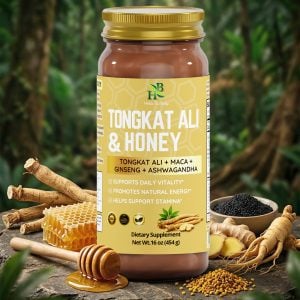 Tongkat Ali Honey 16oz$32.99
 Tongkat Ali – Longjack (Eurycoma Longifolia) – 60 Capsules Original price was: $18.40.$16.56Current price is: $16.56.
 Tongkat Ali Powder – 4oz and 1Lb Price range: $19.99 through $29.99This product has multiple variants. The options may be chosen on the product page
Herb & Other Insights



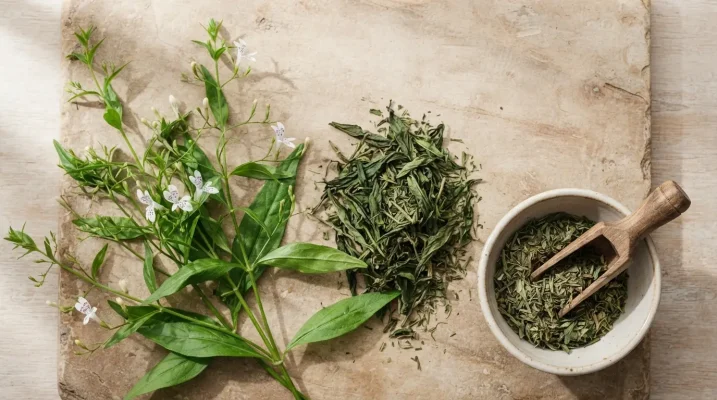






Tongkat ali is the root of Eurycoma longifolia Jack, a slender evergreen tree in the Simaroubaceae family. It is native to Indo-China and western Malesia, including Sumatra, Borneo, the Malay Peninsula, Thailand and Vietnam. The plant is also known as longjack (Long Jack), and pasak bumi. Its root contains quassinoids such as eurycomanone. These compounds give the root its strongly bitter taste.
| Botanical name | Eurycoma longifolia Jack |
| Family | Simaroubaceae |
| Plant part | Root |
| Also known as | Tongkat ali, longjack (Long Jack), Ali’s walking stick, Ali’s umbrella, Malaysian ginseng (Malaysia); pasak bumi, bedara pahit (Indonesia); ian-don, piak saw (Thailand); cay ba binh (Vietnam); tho nan (Laos) |
| Botanical synonyms | Kew accepts Eurycoma longifolia Jack with two subspecies, subsp. eglandulosa (Merr.) Noot. and subsp. longifolia. Heterotypic synonyms listed by Kew under subsp. longifolia include Eurycoma latifolia Ridl., Eurycoma merguensis Planch., Manotes asiatica Gagnep. and Picroxylon siamense Warb. |
| Forms we sell | Tongkat ali root powder (4 oz and 1 lb), Tongkat Ali Longjack capsules (60 count), Tongkat Ali Honey blend (16 oz) |
| Origin | India |
| Key constituents | Eurycomanone, eurycomanols and eurycomalactones (quassinoids); canthin-6-one alkaloids; glycosaponins; triterpenes |
| Taste and aroma | Distinctly bitter, from its quassinoids |
| Conservation status | Not listed by CITES (Species+ search). Genetic diversity is reported to be decreasing due to widespread harvesting. |
01. Botanical Overview
Tongkat ali belongs to the genus Eurycoma in the Simaroubaceae family. Kew accepts the name Eurycoma longifolia Jack, first published in 1822. It is as a flowering, shrubby, slender, slow-growing evergreen tree native to Southeast Asia. A 2016 review in Molecules describes it as a tall, slender, shrubby tree that grows in sandy soil.
The plant carries large compound leaves, tiny reddish flowers and ridged oval fruits called drupes. Its long, twisted roots are the part used. Some authors link the name “tongkat ali”, which means “Ali’s walking stick”, to these roots.
Herb To Body offers tongkat ali root as a tongkat ali root powder, as Tongkat Ali Longjack capsules and in a tongkat ali honey blend.
02. Plant Identification
Distinctive features
- Compound, pinnate leaves on branches that can reach 1 m (about 3.3 ft) long.
- Numerous leaflets, opposite or subopposite, lanceolate to ovate-lanceolate, 5 to 20 cm (about 2 to 8 in) long and 1.5 to 6 cm (about 0.6 to 2.4 in) wide, with smooth margins.
- Tiny, reddish, unisexual flowers arranged densely.
- Ovoid drupes with a distinct ridge, 1 to 2 cm (about 0.4 to 0.8 in) by 0.5 to 1.2 cm (about 0.2 to 0.5 in), turning dark reddish brown when ripe.
- Long, twisted roots with a strongly bitter taste.
Look-alikes and confounding materials
Tongkat ali is not to be confused with three other plants that share the local name. The 2016 Molecules review lists them as including Polyalthia bullata and a Goniothalamus species. The common name “Malaysian ginseng” can also mislead: tongkat ali is a Simaroubaceae plant, not a Panax ginseng. A 2013 journal study notes that many commercial “tongkat ali” extracts are not true Eurycoma longifolia root. It adds that genuine root extracts taste bitter. Common names overlap between species, so the botanical name together with the plant part is the reliable identifier.
03. Habitat and Range
Tongkat ali grows primarily in the wet tropical biome, according to Kew. Its native range covers Borneo, Cambodia, Laos, the Malay Peninsula, Myanmar, the Philippines, Sumatra, Thailand and Vietnam. Health Canada records its geographic area as tropical Asia.
The Molecules review reports that the tree grows in sandy soil and that it is planted mainly in Malaysia to conserve wild plants.
04. Cultivation and Harvesting
The root is the harvested part of tongkat ali, recorded by Health Canada as its source material. Wild supply is under pressure: the genetic diversity of Eurycoma longifolia is reported to be decreasing because of widespread harvesting. The tree is planted mainly in Malaysia to conserve wild plants.
Researchers have studied in vitro production of tongkat ali for sustainable production of its active ingredients. This work includes plantlets and tissues grown in vitro, and adventitious roots grown in balloon-type bubble bioreactors for large-scale root production. DNA methods such as PCR-RAPD have been used to tell cultivated samples apart by origin.
05. Constituents
Chemical analyses of Eurycoma longifolia extracts have identified more than 65 compounds, according to LiverTox (NCBI). The main named groups are:
- Quassinoids: eurycomanone, eurycomanols and eurycomalactones.
- Alkaloids: canthin-6-one alkaloids.
- Glycosaponins.
- Other groups: phenolic derivatives, coumarin, tannins and triterpenes.
A 2013 study in the Journal of the International Society of Sports Nutrition notes that quassinoids are among nature’s bitterest compounds. It reports that properly standardized hot-water root extracts taste distinctly bitter because they contain quassinoids. LiverTox notes that it is not clear which of these compounds account for the activities attributed to tongkat ali.
Commercial tongkat ali products vary widely in extraction method, concentration and standardization. LiverTox notes that there is no standardization of purity or concentration across the extracts used. The same 2013 study observed that many commercial supplements state extract ratios from 1:20 to 1:200 without constituent or extraction details. These figures describe products on the market, not properties of tongkat ali root itself.
06. Traditional Use
The Journal of the International Society of Sports Nutrition study states that decoctions of tongkat ali roots “have been used for centuries in Malaysia and Southeast Asia”. LiverTox reports that the leaves, roots and bark of Eurycoma longifolia have been used extensively in traditional medicine in Southeast Asia. The 2016 Molecules review records its use as “a power tonic after delivery”.
These historical uses do not establish that tongkat ali can diagnose, treat, cure, or prevent any disease.

07. Safety and Responsible Use
- NCBI reports that side effects of tongkat ali at conventional doses are uncommon but may include nausea, abdominal discomfort, diarrhea, headaches and rash.
- NCBI states that the long-term safety of tongkat ali has not been well documented in humans. The effects of long-term use and higher doses have not been assessed.
- NCBI records isolated reports of liver injury in people taking tongkat ali, mostly young male body builders. It rates tongkat ali a “possible rare cause of clinically apparent liver injury” (likelihood score D). It notes that possible anabolic steroid use weakens that evidence.
- NCBI notes that cases may be more frequent and more severe in people with preexisting liver disease, and that most clinical studies excluded such people.
- A 2016 review reports that a water-based tongkat ali extract decreased the bioavailability of propranolol in a study of healthy men. Tongkat ali may reduce propranolol exposure, so the review advises caution for people using propranolol.
- The same review advises caution for people using blood glucose medicines, and for people with weakened immune systems.
- Talk with a qualified healthcare professional before using tongkat ali, especially if you take medication, have a liver condition, or are pregnant or breastfeeding.
08. References
- Royal Botanic Gardens, Kew. “Eurycoma longifolia Jack.” Plants of the World Online. powo.science.kew.org (accessed October 31, 2026).
- Health Canada. Natural Health Products Ingredients Database. “Organism: Eurycoma longifolia” (source material: root).
- Tongkat Ali.” LiverTox: Clinical and Research Information on Drug-Induced NCBI Bookshelf NBK609015, PMID 39527684. Last update October 18, 2024.
- Rehman SU, Choe K, Yoo HH. “Review on a Traditional Herbal Medicine, Eurycoma longifolia Jack (Tongkat Ali): Its Traditional Uses, Chemistry, Evidence-Based Pharmacology and Toxicology.” Molecules. 2016;21(3):331. doi:10.3390/molecules21030331. PMID 26978330.
- Talbott SM, Talbott JA, George A, Pugh M. “Effect of Tongkat Ali on stress hormones and psychological mood state in moderately stressed subjects.” Journal of the International Society of Sports Nutrition. 2013;10:28. doi:10.1186/1550-2783-10-28. PMID 23705671.
- CITES. Species+ database search for Eurycoma: no CITES listing returned (checked November 3, 2026).
Product disclaimer
For educational purposes only. This information has not been evaluated by the U.S. Food and Drug Administration. It is not intended to diagnose, treat, cure, or prevent any disease. Consult a qualified healthcare professional before making changes to your diet or using herbal products, especially if you take medication or have an existing health condition.