


Sea Moss
Best Sea Moss to Buy in 2026: Forms, Species & Quality
Sea moss is one of the most popular sea vegetables on the market. But the quality varies a lot between brands. This guide helps you pick the right type, form, and source. So you get real benefits, not just marketing claims.
We cover every form: raw sea moss, gel, capsules, powder, and gummies. We explain how to read a Certificate of Analysis (COA). And we show you exactly what separates high-quality sea moss from low-quality sea moss. If you already know which form you want, see our detailed form comparison guide for a side-by-side breakdown.
What Is Sea Moss?
Sea moss is a red algae. It grows along Atlantic and Caribbean coastlines. People have eaten it for centuries in Ireland, Jamaica, and West Africa.
Sea moss is rich in iodine, fucoidan, and natural carrageenan. A plant-based gel-forming compound. It contains up to 92 trace minerals, including zinc, magnesium, potassium, and selenium.
Today it is sold in several forms: raw, gel, capsules, powder, and gummies. Each form has a different use case, potency level, and price point.
Quick definition: Sea moss (Chondrus crispus) is a red algae native to the North Atlantic. It is used as a food, supplement, and natural thickener.
The Three Main Sea Moss Species
Not all sea moss is the same species. Most products on the market use one of three types. Each has a different flavor, nutrient profile, and country of origin.
| Species | Common Name | Origin | Best Known For |
| Chondrus crispus | Irish Moss | Ireland, Canada, New England | Highest mineral density, authentic Atlantic source |
| Gracilaria | Gold / Purple Sea Moss | Caribbean (St. Lucia, Jamaica) | Mild flavor, great for gel-making |
| Eucheuma cottonii | Pool-Grown Sea Moss | Asia (Philippines, Indonesia) | Low cost, high volume production |
Chondrus crispus is the true Irish moss. It is the species most studied for nutritional benefits. Many budget products use Eucheuma cottonii – a pool-grown variety with a lower nutrient profile.
When a brand does not list the species on the label, that is a red flag.
Sea Moss Forms: Which One Should You Buy?
There are five main forms of sea moss available today. Each suits a different lifestyle and health goal. For a full side-by-side comparison of forms, read our sea moss gel vs. capsules vs. powder guide.

1. Raw Sea Moss (Dried)
Raw sea moss is dried seaweed. You soak it, blend it, and make your own gel at home. This is the most affordable option. It is also the most transparent – you can inspect the product before you use it.
Raw sea moss keeps for 12 to 24 months when stored dry. Once you make gel, it lasts 2 to 4 weeks in the fridge.
- Best for: people who want to control quality and make fresh gel at home.
- Not ideal for: people who want convenience or precise daily dosing.
2. Sea Moss Gel
You blend soaked raw sea moss with water into a smooth gel. Brands sell it in jars, ready to use. Either you can make your own and use it at home. You can add it to smoothies, soups, sauces, or take it by the spoon.
Gel goes bad faster than other forms. It must be refrigerated. Shelf life is usually 4 to 6 weeks. Some brands add preservatives to extend this. Before starting to use, check the label.
- Best for: daily smoothie users who want a food-first supplement.
- Watch out for: brands that do not refrigerate their gel during shipping.
Check simple guide to how to make sea moss gel
3. Sea Moss Capsules
Capsules contain dried, powdered sea moss in a gelatin or vegetable shell. It also comes with a long shelf life – usually 1 to 2 years. They are the most popular form for supplement users.
Many capsule products combine sea moss with bladderwrack and burdock root. This combination is sometimes called the Dr. Sebi formula. Bladderwrack adds extra iodine and fucoidan.
- Best for: supplement routines, travel, precise daily dosing.
- Look for: 1,000 mg per serving minimum, no fillers listed in the ingredient panel.
4. Sea Moss Powder
Powdered sea moss is the most versatile form. You can add it to smoothies, oatmeal, baked goods, or capsules you fill yourself. It is usually the most cost-effective per gram.
Quality varies more in powder than in capsules. Low-quality powder may be cut with fillers or maltodextrin. Always look for single-ingredient powder with no additives.
For a deep dive into powder-specific benefits and uses, see our sea moss powder guide.
- Best for: people who cook or blend daily and want to add sea moss seamlessly.
- Look for: 100% pure sea moss with no maltodextrin or anti-caking agents.
5. Sea Moss Gummies
Seamoss Gummies are the newest form on the market. They are convenient and have a pleasant taste. However, they usually contain the lowest amount of actual sea moss per serving.
Most gummies contain 200 to 500 mg of sea moss per serving. Compare that to 1,000 to 1,500 mg in a standard capsule. Gummies also typically contain added sugar, pectin, and natural flavors.
- Best for: people who dislike swallowing capsules or the taste of sea moss.
- Not ideal for: those seeking therapeutic-level mineral intake from sea moss alone.
Wildcrafted vs. Pool-Grown: Why It Matters
This is one of the most important distinctions in sea moss quality. It affects mineral content, environmental impact, and what you are actually getting for your money.
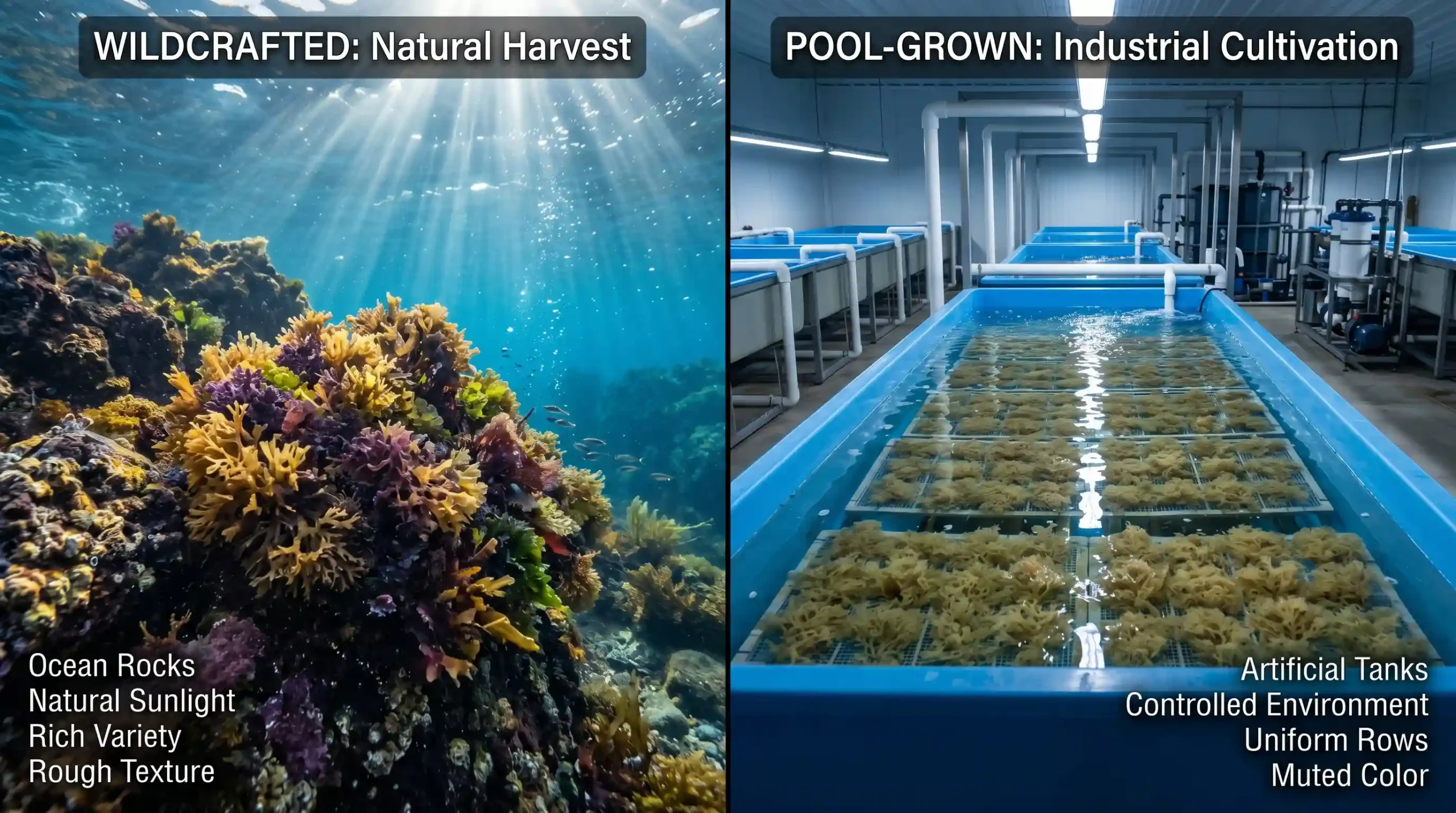
| Factor | Wildcrafted Sea Moss | Pool-Grown Sea Moss |
| Growth environment | Open ocean – absorbs minerals from seawater naturally | Tanks or enclosed pools – fed synthetic nutrients |
| Mineral content | Higher – naturally occurring trace minerals from the sea | Lower – limited to what is added to the pool water |
| Texture (raw) | Firm, rough texture. Sea salt present. No uniform shape. | Smooth, uniform, slimy. Little to no salt smell. |
| Price | Higher – reflects harvesting labor and location | Lower – easier to produce at scale |
| Common species | Chondrus crispus, Gracilaria | Eucheuma cottonii (mainly) |
| How to identify (raw) | Earthy ocean smell. Salt crystals visible. Color varies naturally. | Little smell. Uniform color. Almost no salt residue. |
Wildcrafted sea moss grown in the open ocean delivers more naturally occurring minerals. If a brand does not state ‘wildcrafted’ and specify the harvest location, assume it is pool-grown.
How to Evaluate Sea Moss Quality: The COA Guide
A Certificate of Analysis (COA) is a lab report. It shows exactly what is and is not in a sea moss product. Any brand that takes quality seriously should provide one.
Here is what to look for in a COA:
- Heavy metal panel: Check for lead, arsenic, mercury, and cadmium. Sea moss absorbs from its environment. High-quality products test below FDA limits.
- Iodine levels: Sea moss is a high-iodine food. A COA confirms the exact iodine content. Too little means poor quality. Too much (above 1,100 mcg daily) can affect thyroid function.
- Microbial testing: Confirms the product is free from harmful bacteria, mold, and yeast.
- Species identification: Some COAs confirm the species tested. This rules out filler algae.
- Third-party lab: Always check that the COA is from an independent lab not just the brand’s own report.
Tip: If a brand does not publish a COA or refuses to provide one on request, choose a different brand.
5 Red Flags When Buying Sea Moss
These warning signs indicate a low-quality or misleading product. Avoid any sea moss that shows more than one of these.
- No species listed: A label that just says sea moss gives you no information about what you are buying.
- No harvest location: ‘Caribbean’ is not a location. Look for country and region: St. Lucia, Jamaica, Atlantic coast, etc.
- No COA available: This is a non-negotiable quality signal. Reputable brands publish it prominently.
- Unusually low price: Wildcrafted sea moss costs more to harvest and ship. If the price seems too good, the source is likely pool-grown or mislabeled.
- Expired or undated gel: Always check the manufacturer and expiration date on gel products. Gel with no date should not be used.
Read More: How To Check Real Sea Moss?
Which Sea Moss Is Best for Your Goal?
Different goals call for different forms and species. Use this table to find your best starting point.
| Health Goal | Best Form | Best Species | Key Nutrients to Check |
| Thyroid support* | Capsules | Chondrus crispus | Iodine (verify COA level) |
| Gut health / digestion* | Gel or raw | Gracilaria or Chondrus crispus | Prebiotic fiber, carrageenan |
| Skin and hair* | Gel (topical or ingested) | Gracilaria | Collagen-support minerals, zinc |
| Energy and stamina* | Capsules or powder | Chondrus crispus + bladderwrack | Iron, magnesium, B vitamins |
| Daily wellness (easy) | Gummies or capsules | Any | Check mg per serving vs. daily target |
| Cooking and recipes | Powder or raw | Gracilaria (mild flavor) | Texture, gel strength |
Where to Buy Sea Moss Online?
Buying sea moss online gives you access to more transparent brands than you will typically find in a local store. Here is what the best online sources offer:
- Published COAs: Available on the product page or by email request, no need to chase them.
- Clear origin labeling: Country, region, and harvesting method listed for every product.
- Species transparency: Latin name on the label or product description.
- Honest dosing: Milligrams per serving stated clearly, not buried in small print.
If you are ready to compare specific products, see our curated sea moss product range at Herb To Body. Each product listing includes origin details, form, and species information.
About Herb To Body
Herb To Body is a sea moss brand based in the United States. We source wildcrafted sea moss from the Caribbean and Atlantic. Our products include raw sea moss, gel, capsules, powder, sea moss bitters, and blended formulas.
Every batch is tested for heavy metals, microbial safety, and iodine content. We publish our COAs on our product pages. Our team includes nutrition educators and supplement specialists who review sourcing standards annually.
We believe in full ingredient transparency. Our labels list species, origin, and form. If you ever have a question about our sourcing or testing, contact us directly at herbtobody.com.
Browse all sea moss products at Herb To Body’s sea moss collection.
A Note on Sea Moss Safety
Sea moss is a food. Most healthy adults can consume it without issues. That said, there are a few things worth knowing before you start.
- Iodine sensitivity: Sea moss is high in iodine. People with thyroid conditions should speak with a doctor before adding high-iodine foods to their routine.*
- Gel storage: Pre-made gel must be refrigerated. Use within the date on the label. Do not use gel that smells off or has mold.
Sea moss does not replace medical treatment. It is a supplement to a balanced diet, not a cure or medication.
Ready to Buy? Here Is Where to Start
Choosing the right sea moss comes down to three things: form, species, and sourcing standards. Use the decision matrix above to match your health goal to a form. Then verify the COA before you buy.
| I want | Start with | Herb To Body product |
| Convenience and consistent dosing | Sea moss capsules | Sea Moss Capsules (wildcrafted) |
| Food-first daily supplement | Sea moss gel | Caribbean Gold Sea Moss Gel |
| Smoothies and cooking | Sea moss powder | Pure Sea Moss Powder (single ingredient) |
| Make my own gel at home | Raw sea moss | Wildcrafted Raw Sea Moss (multiple varieties) |
Summary
The best sea moss to buy comes down to three things: species, source, and a COA from an independent lab. If a brand cannot provide all three, move on. Wildcrafted sea moss delivers more naturally occurring minerals than pool-grown alternatives. Chondrus crispus is the most studied species. Gracilaria in gel or powder form is the most practical for daily use.
Match your form to your lifestyle. Capsules work best for consistent dosing. Gel and raw suit people who cook or blend. Gummies are the most convenient but the lowest potency per serving. Ignore labels that say “Caribbean source” or “100% natural” without specifics. Real quality shows up in the lab report, not the label design.
Frequently Asked Questions (FAQ)
The best sea moss is wildcrafted, comes from a named location (such as St. Lucia or Ireland), and has a published COA from an independent lab. Chondrus crispus is the species most commonly used in supplements. The best form depends on your lifestyle. Capsules for convenience, gel for food use, powder for cooking.
Yes and no. Irish moss refers specifically to Chondrus crispus, a species native to Ireland and the North Atlantic. ‘Sea moss’ is a broader term that includes Gracilaria and Eucheuma cottonii. Many products labeled ‘sea moss’ use Gracilaria or Eucheuma – not true Chondrus crispus.
Look for brands that publish COAs, list species and harvest location, and clearly state dosing information. Herb To Body’s sea moss collection includes wildcrafted options across all five forms with full sourcing transparency.
Real wildcrafted sea moss has a natural ocean smell, visible sea salt, and irregular shapes. It should feel firm and slightly rough when dry. Pool-grown sea moss is often uniform in shape, smooth, and has almost no smell. Always ask for a COA from an independent lab.
Most guidance suggests 1 to 2 tablespoons of gel per day, or 1,000 to 1,500 mg in capsule form. Do not exceed recommended amounts, as sea moss is high in iodine. The tolerable upper limit for iodine is 1,100 mcg per day for adults. Check your product’s COA for exact iodine levels.
Sea moss contains zinc, sulfur, and collagen-supporting minerals that are relevant to skin and hair health. It is used both as a dietary supplement and as a topical ingredient. For detailed information on sea moss benefits, see our sea moss benefits guide.
Disclaimer: *These statements have not been evaluated by the Food and Drug Administration. This product is not intended to diagnose, treat, cure or prevent any disease.

Columbus Day 2026: History, Plants of the Columbian Exchange
Many foods and herbs we use today including chili peppers, cacao, vanilla, tomatoes, and potatoes,...
Oct

Vitamin C Powder: Forms, Dosage, Safety, and How to Choose
Vitamin C powder is a dissolvable supplement that is usually made with ascorbic acid or...
Oct

Goldenseal Root: Uses, Dosage, Safety & How to Buy It
What Is Goldenseal Root? Goldenseal root is a bitter yellow herb with a long history...
Oct
Andrographis Paniculata: Benefits, Herb Profile, Uses, Dosage & Safety
Andrographis paniculata is a bitter medicinal herb from the Acanthaceae family, often called “King of...
Sep

Patriot Day: History, Facts, and 9/11 Remembrance
Patriot Day is a day of remembrance. It is held every year on September 11th...
Sep

Olive Leaf: Benefits, Active Compounds, and How to Use It
We all use or have heard about olive oil. But did you know that the...
Sep
Labor Day Sale: Fresh Fall Botanicals
Update: The Herb To Body Labor Day 2026 sale ended on Monday, September 7, 2026,...
Sep
Astragalus Root: Benefits, Uses, Dosage & Safety
Astragalus root, also known as huang qi, comes from a plant in the pea family...
Aug

What Is Echinacea: Benefits, Active Compounds, Types, Uses and Who Should Avoid It?
When the cold season arrives, many people add a traditional botanical such as Echinacea to...
Aug

Elderberry (Sambucus nigra): What It’s Used For, Potential Benefits & Safety
Every autumn, the same scene plays out – someone at home starts sniffling. Through the...
Aug
Immune Supporting Herbs: Forms, Uses & Safety Guide
What is an Immune Support Herb? An immune-support herb is a plant traditionally used for...
Aug

Back to School Wellness: A Routine for the Whole School Year
The first bell of the school year changes a household’s routine overnight. Bedtimes shift earlier,...
Aug
Herbs for Women: Traditional Uses, Research Notes and Safety
Many women wellness seekers search for simple herbs to add to a daily routine. Some...
1 Comment
Aug

Oat Straw Tea: Benefits, Uses & How to Brew and Use Perfectly?
What Is Oat Straw Tea? Oat straw tea is a mild herbal tea made from...
Jul
Shikakai Powder: Benefits, Active Compounds, Uses and Safety
Long before bottled shampoo existed, people in South Asia reached for a dried legume pod...
Jul

Mugwort Tea: Benefits, Brewing, Flavor & the Safety Concern No One’s Telling You
Mugwort tea (Artemisia vulgaris), also known as the “Mother of Herbs,” holds a storied place...
Jul
Wormwood Herb: Benefits, Side Effects, Uses, Compounds & More
Wormwood (Artemisia absinthium) is one of the most famous and intensely bitter herbs in traditional...
Jul

Wheatgrass Juice Powder: Benefits, Nutrients, Uses, Taste Comparison & Buying Guide
In a perfect world, we’d all eat fresh greens every single day. But reality hits...
Jul