


Calendula
Calendula Flower: What It Is, How to Use It & What Science Says
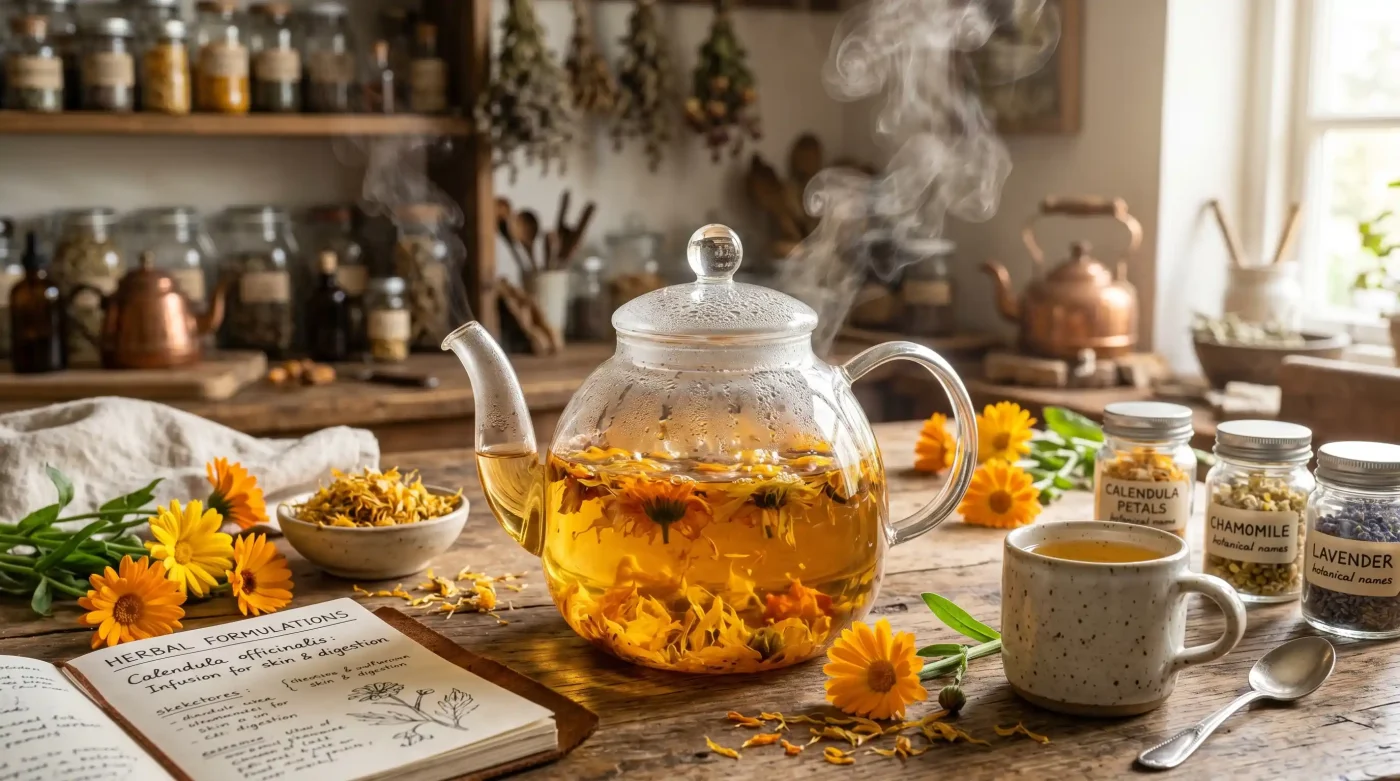
While many recognize the bright orange petals of Calendula officinalis (Pot Marigold), its role in modern medicine is far more significant. Backed by decades of phytochemical research and published research, Calendula has moved from “folk remedy” to a well-characterised herbal ingredient.
Calendula officinalis appears in traditional topical formulations used alongside dermatological applications. However, not all calendula is equivalent – its compound profile depends on harvest timing and extraction methods.
The Science of Calendula: Why It Works
Beyond its use in traditional remedies, Calendula officinalis has been well characterised in published research. Here is why it’s a well-researched option for certain skin recovery contexts:*
The Power of Triterpenoids
Research identifies the triterpenoid fraction as a key group, delivering compounds studied for tissue support (Neukirch et al., 2001).
Research Notes
Calendula has been the subject of published clinical research into its role in supporting normal skin recovery.
Key Recognition
It holds official monographs from the European Medicines Agency (EMA) and Commission E for supporting skin health and oral mucosa.*
Safety Profile
When sourced from verified whole flower heads, it is well tolerated in adult topical use.
What Is Calendula?
Calendula (Calendula officinalis) is a flowering plant in the daisy family (Asteraceae). Its bright orange and yellow petals, the dried flower heads – are the part used in teas, oils, creams, and tinctures.
Identification
People often confuse it with ornamental marigolds (Tagetes species). These are different plants. Calendula officinalis is the medicinal species. If a product says “calendula,” check that it names Calendula officinalis on the label.
Historical Use
It has been used in traditional herbal practice across Europe and the Mediterranean for centuries – for skin care, wound support, and general function.
Regulatory Status
Calendula officinalis appears in the European Medicines Agency community herbal monograph (EMA/HMPC/179282/2009) and is featured in Germany’s Commission E monographs for traditional uses – reflecting decades of phytochemical characterisation and controlled clinical research.
What’s Inside the Flower?
Calendula’s reputation comes from its compound profile. Four groups do most of the work:
Isorhamnetin
Confirmed as a primary flavonol in Calendula officinalis petals, primarily as 3-O-glucoside and 3-O-rutinoside. Fernandez-Arroyo et al. (2012) in Phytochemical Analysis identifies it as a key bioactive; studies note its presence and COX-2/lipoxygenase associations.
(Source: Pubmed)
Triterpenoids (oleanolic/ursolic acid, faradiol esters)
Accurate – faradiol 3-O-palmitate/myristate are principal actives in resin. Neukirch et al. (2001) in Pharmazie isolated them, showing dose-dependent effects in models; lipophilic, best in oil extracts.
Lutein
Dominant carotenoid (44-73% of total), per Kishimoto et al. (2005) in Phytochemistry; deeper orange varieties have higher levels.
Polysaccharides (PS-I, PS-II)
Varjen et al. (1998, not 1990; Arzneimittelforschung) characterized high-MW heteroglycans (arabinose/galactose/etc.); water-soluble, immune receptor interactions in labs; hot-water optimal.
Compound Summary
| Compound | Class | Extracted By | Primary Application | Key Evidence |
| Isorhamnetin glycosides | Flavonoid | Oil + Water | Skin calming, COX-2/LOX modulation | Fernandez-Arroyo et al. 2012 |
| Faradiol esters | Triterpenoid | Oil only | Wound healing, skin recovery | Neukirch 2001; Pommier 2004 RCT |
| Lutein | Carotenoid | Oil only | Antioxidant, UV-stress support | Kishimoto 2005 |
| PS-I, PS-II heteroglycans | Polysaccharide | Water only | Immune-adjacent, mucosal support | Varjen 1990 |
Note: The European Pharmacopoeia (10th Ed.) sets a minimum 0.4% total flavonoid content for pharmaceutical-grade dried Calendula officinalis flowers.
What People Use Calendula For
Dry or Irritated Skin*
Calendula-infused oils and creams are an established topical preparation in botanical skincare. The triterpenoid fraction is the primary compound class relevant to this application.*
Post-Sun Skin Support*
Lutein, the dominant carotenoid in Calendula officinalis flowers, has been studied for antioxidant activity in UV-exposure contexts.*
General Skin-Soothing Routines*
Widely used in sensitive skin formulations for adults. Calendula officinalis extract frequently appears as the primary active in botanical skincare ingredient lists.
Supporting the Body’s Normal Skin Recovery Processes*
Faradiol triterpenoids are the focus of multiple laboratory studies and two published randomised controlled trials.
A Gentle Daily Herbal Tea
Calendula flower infusion delivers polysaccharides and flavonoid glycosides – the fractions with immune-adjacent and mucosal properties in laboratory models.*
*These statements have not been evaluated by the Food and Drug Administration. This product is not intended to diagnose, treat, cure, or prevent any disease.
3 Ways to Use Calendula
1. Calendula-Infused Oil or Cream (Most Studied for Skin)
This is where the triterpenoids concentrate. Because faradiol and oleanolic acid are lipophilic, a fat-based preparation is required to extract and deliver them to skin.
Check the Label
Check for “Calendula officinalis flower extract” or “infused in (carrier oil).” Vague terms like “calendula essence” typically reflect fragrance preparations with negligible triterpenoid content.
How People Use It
Apply to dry patches, chapped skin, minor surface irritation, or as part of a daily moisturising routine. Commonly used for dry skin (xerosis), minor surface irritation, and chapped areas.*
Tips
Cold infusion: Whole flowers soaked in olive or jojoba oil for 4–6 weeks at room temperature is preferred for compound preservation: it maintains heat-sensitive flavonoid compounds, including isorhamnetin, more fully than warm-processed methods.
2. Calendula Tea
Dried Calendula officinalis flowers produce a mild, slightly bitter, golden-coloured infusion.
Extraction
Water-soluble PS-I and PS-II polysaccharides and flavonoid glycosides extract well at 85–90°C in 10–15 minutes.
Use
1–2 g dried flowers per cup, steeped 10 minutes. Up to 3 cups daily is cited in traditional herbalism. Taste is mild – slightly floral, slightly earthy.
Distinction
Tea extracts the water-soluble fraction only. It does not capture triterpenoids, which remain in the plant material and require oil-based extraction.
3. Tincture
A tincture made with 60–70% ethanol extracts both the water-soluble and oil-soluble fractions, making it the most comprehensive single-preparation form. Commission E specifically references tincture as an appropriate preparation for oral and mucosal applications.
Standard Dose in Traditional Herbal Practice
2–4 ml in water, 2–3 times daily.
Look for tinctures that state the herb-to-liquid ratio (1:5 is standard) and the ethanol percentage.
What Does Research Actually Say?
The Evidence Hierarchy: Preclinical (Laboratory and Experimental Models)
Neukirch et al. (2001, Pharmazie) isolated the faradiol ester fraction and demonstrated dose-dependent topical activity in experimental models – establishing the mechanistic basis for clinical application.
Separate laboratory work has characterised isorhamnetin’s modulation of COX-2 and lipoxygenase pathways, and Varjen et al. (1990) characterised the PS-I/PS-II polysaccharide fractions and their interaction with immune cell surface receptors.
Controlled Clinical Trials: Radiation Dermatitis (2004 RCT)
Pommier et al. (Journal of Clinical Oncology, PMID:15577908) compared calendula ointment against trolamine in some patients. The calendula group showed statistically lower grades of acute dermatitis.*
Post-Surgical Skin Recovery (2009 RCT)
Comparing calendula cream to petroleum jelly, the calendula group showed improved skin recovery outcomes and lower rates of surface irritation. (PMID:19415899)
In Plain Terms
The preclinical evidence establishes mechanism; the clinical trials confirm human-context activity – but in specific populations, not general dry skin or everyday irritation.
General skin integrity use is a different context from a clinical intervention. The evidence supports the plausibility of topical benefit; individual outcomes vary.

How Calendula Compares to Other Skin Herbs?
Calendula is among the better-documented botanicals in its category.
German chamomile (Matricaria chamomilla) has Commission E approval for skin irritation and GI mucosal applications, with its bisabolol fraction targeting irritation-specific mechanisms that calendula’s triterpenoid profile does not address.
The two herbs are complementary:
- Calendula for wound and recovery contexts.*
- Chamomile for irritation and calming.*
Calendula’s Traditional Uses by System
Skin (Integumentary System)*
The triterpenoid fraction is the primary driver of calendula’s documented topical activity.
Faradiol 3-O-palmitate and faradiol 3-O-myristate are the compounds most studied in wound and skin recovery contexts. Neukirch et al. (2001) demonstrated dose-dependent activity for this fraction.
The isorhamnetin flavonoid fraction, which modulates enzyme pathways associated with the body’s normal tissue-stress response, contributes alongside the triterpenoids in oil-based preparations.*
Immune System*
The polysaccharide fraction – specifically PS-I and PS-II – appears to interact with immune cell receptors in laboratory models.
These are extracted only by hot water, which is why tea and aqueous preparations are the traditional formats for systemic functional use rather than topical application.
The PS-I/PS-II characterisation provides the mechanistic basis for calendula’s centuries-long use as a seasonal functional herb.*
Digestive System (Oral and Mucosal Support)*
Commission E’s monographs explicitly include traditional use for inflammatory conditions of the oral and pharyngeal mucosa.
The polysaccharide and flavonoid glycoside fractions that extract into hot water are the relevant compounds here.
Calendula tea and 60–70% ethanol tinctures are used in traditional practice to support healthy oral and throat mucosa.
Topical oil preparations are not relevant for this system.*
Important Things to Know Before You Use It
1. Asteraceae Allergy – Check This First
If you’re allergic to chamomile, echinacea, or ragweed, cross-reactivity with Calendula officinalis is possible.
Patch Test
Apply a small amount to your inner wrist. Wait 24 hours. If you see redness, swelling, or itching, discontinue use and consult a healthcare provider.
2. Pregnancy – Avoid Oral Use
Calendula officinalis has been used historically as an emmenagogue.
Oral supplementation is not recommended during pregnancy. Topical use on limited skin areas is generally considered lower risk, but no definitive safety data exists.
Consult your healthcare provider before use.
What to Look for in a Calendula Product?
Whole Flower Heads, Not Petals Only
Faradiol esters concentrate in the resinous layer of the whole flower head. Petal-only preparations have measurably lower triterpenoid content and are not appropriate for medicinal-purpose preparations.
Deep Orange-Yellow Color
The carotenoid fraction produces the characteristic pigmentation. Fading or browning indicates carotenoid oxidation – a pale dried flower will produce a measurably weaker infused oil.
Verified Botanical Identity
Calendula officinalis and Tagetes species are different plants. Botanical identity must be confirmed by third-party testing – label claims alone are insufficient.
Harvest Timing and Storage Documentation
Compound density peaks at full bloom. Post-harvest exposure to heat and humidity degrades quality. Look for sealed, dark packaging.
Which Form Is Right for You?
| Your Goal | Best Form | Why |
| Dry, chapped, or irritated skin | Infused oil or cream | Oil extraction captures faradiol triterpenoids |
| Surface skin or wound recovery | Cold-infused whole flower oil | Maximises faradiol ester and lutein concentration |
| General daily herbal function | Dried flower tea (1–2 g/cup) | Delivers PS-I/PS-II and flavonoid glycosides |
| Oral or mucosal support | Tea or tincture (60–70% ethanol) | Commission E approved; both fractions present in tincture |
| Broadest single-prep coverage | Tincture (60–70% ethanol, 1:5 ratio) | Extracts both lipophilic and hydrophilic fractions |
| DIY salve or formulation base | Cold infusion in olive or sunflower oil | Full triterpenoid and carotenoid extraction over 4–6 weeks |
Conclusion
Calendula officinalis remains one of the most researched herbs for topical skin support and traditional herbal wellness. Its naturally occurring compounds have been studied for their role in supporting normal skin recovery processes and maintaining healthy skin function.*
Whether used as an infused oil, cream, tea, or tincture, the quality of the flower material and extraction method play a major role in the final product’s effectiveness. For best results, choose verified Calendula officinalis whole flower preparations sourced and stored to preserve active compounds.
Sources
- PMID:15577908
- PMID:19415899
- PMID:28442897
- PMID:35187649
- PMID:23017531
- Neukirch et al. (2001), Pharmazie 56(12):967–970
- Varjen et al. (1990), Arzneimittelforschung 40(9):1055–1058
- Fernandez-Arroyo et al. (2012), Phytochemical Analysis
- Kishimoto et al. (2005), Phytochemistry
- European Medicines Agency, Community Herbal Monograph on Calendula officinalis L., flos (EMA/HMPC/179282/2009)
Frequently Asked Questions (FAQ)
In traditional herbal practice, Calendula officinalis is used primarily for skin integrity like dry, irritated, or recovering skin, and as a gentle herbal tea. Research suggests it may support normal skin recovery processes, though it is not a medical treatment.*
No. Calendula officinalis (pot marigold) and Tagetes species (ornamental marigolds) are different plants with different compound profiles. Check the Latin name on any product label.
For topical skin use, an infused oil or oil-in-water cream concentrates the triterpenoid compounds (faradiol esters, oleanolic acid) most relevant to skin support. Hot-water preparations deliver polysaccharides and flavonoid glycosides, relevant for oral and mucosal applications but not for topical skin activity. The best form depends entirely on the application.*
Topical creams and oils are generally considered suitable for daily use on intact skin. Daily tea consumption up to 3 cups is cited in traditional herbalism.
Theoretical interactions exist with some prescription medicines. Disclose all herbal supplement use to your doctor.*
Calendula is better documented in published research and holds a Commission E monograph. German chamomile has stronger evidence for skin irritation via its bisabolol fraction.
Disclaimer: *These statements have not been evaluated by the Food and Drug Administration. This product is not intended to diagnose, treat, cure or prevent any disease.

Columbus Day 2026: History, Plants of the Columbian Exchange
Many foods and herbs we use today including chili peppers, cacao, vanilla, tomatoes, and potatoes,...
Oct

Vitamin C Powder: Forms, Dosage, Safety, and How to Choose
Vitamin C powder is a dissolvable supplement that is usually made with ascorbic acid or...
Oct

Goldenseal Root: Uses, Dosage, Safety & How to Buy It
What Is Goldenseal Root? Goldenseal root is a bitter yellow herb with a long history...
Oct
Andrographis Paniculata: Benefits, Herb Profile, Uses, Dosage & Safety
Andrographis paniculata is a bitter medicinal herb from the Acanthaceae family, often called “King of...
Sep

Patriot Day: History, Facts, and 9/11 Remembrance
Patriot Day is a day of remembrance. It is held every year on September 11th...
Sep
Olive Leaf: Benefits, Active Compounds, and How to Use It
We all use or have heard about olive oil. But did you know that the...
Sep
Labor Day Sale: Fresh Fall Botanicals
Update: The Herb To Body Labor Day 2026 sale ended on Monday, September 7, 2026,...
Sep
Astragalus Root: Benefits, Uses, Dosage & Safety
Astragalus root, also known as huang qi, comes from a plant in the pea family...
Aug
What Is Echinacea: Benefits, Active Compounds, Types, Uses and Who Should Avoid It?
When the cold season arrives, many people add a traditional botanical such as Echinacea to...
Aug
Elderberry (Sambucus nigra): What It’s Used For, Potential Benefits & Safety
Every autumn, the same scene plays out – someone at home starts sniffling. Through the...
Aug
Immune Supporting Herbs: Forms, Uses & Safety Guide
What is an Immune Support Herb? An immune-support herb is a plant traditionally used for...
Aug

Back to School Wellness: A Routine for the Whole School Year
The first bell of the school year changes a household’s routine overnight. Bedtimes shift earlier,...
Aug
Herbs for Women: Traditional Uses, Research Notes and Safety
Many women wellness seekers search for simple herbs to add to a daily routine. Some...
1 Comment
Aug
Oat Straw Tea: Benefits, Uses & How to Brew and Use Perfectly?
What Is Oat Straw Tea? Oat straw tea is a mild herbal tea made from...
Jul
Shikakai Powder: Benefits, Active Compounds, Uses and Safety
Long before bottled shampoo existed, people in South Asia reached for a dried legume pod...
Jul

Mugwort Tea: Benefits, Brewing, Flavor & the Safety Concern No One’s Telling You
Mugwort tea (Artemisia vulgaris), also known as the “Mother of Herbs,” holds a storied place...
Jul
Wormwood Herb: Benefits, Side Effects, Uses, Compounds & More
Wormwood (Artemisia absinthium) is one of the most famous and intensely bitter herbs in traditional...
Jul

Wheatgrass Juice Powder: Benefits, Nutrients, Uses, Taste Comparison & Buying Guide
In a perfect world, we’d all eat fresh greens every single day. But reality hits...
Jul