


Goldenseal Root
Botanical Profile of
Goldenseal Root
plant overview
shopping goldenseal root – three varieties
 Goldenseal Herb Powder Original price was: $49.99.$41.99Current price is: $41.99.You're on the list ✓
 Goldenseal Leaf C/S$51.98You're on the list ✓
 Goldenseal Root Powder$51.99
Herb Insight

01. Botanical Overview
A woodland perennial herb
Goldenseal (Hydrastis canadensis L.) is a small, slow-growing perennial herb in the buttercup family, Ranunculaceae. It is native to the shaded hardwood forests of eastern North America.
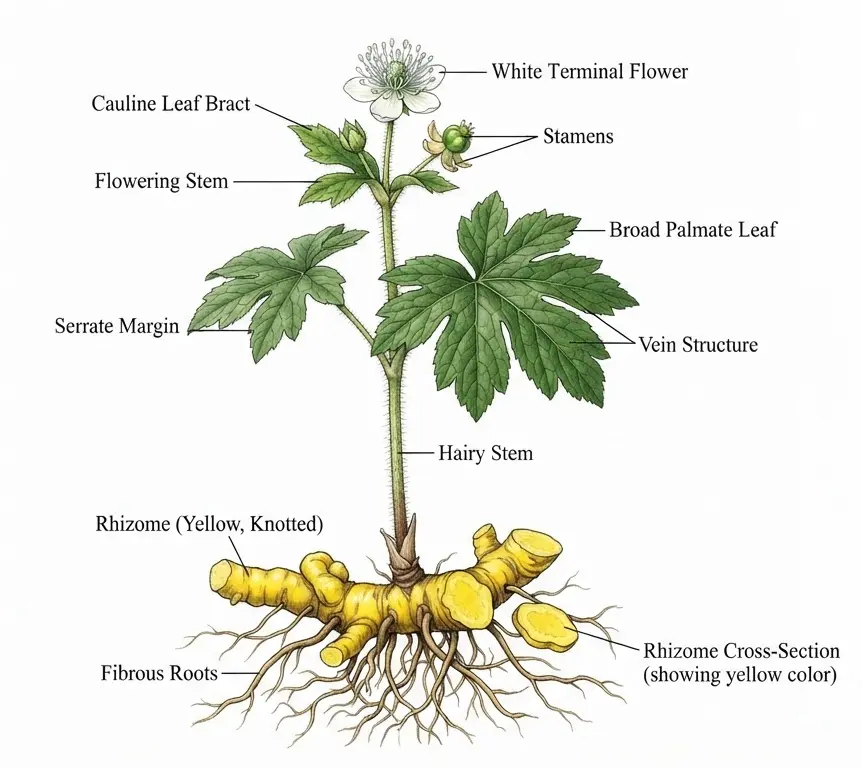
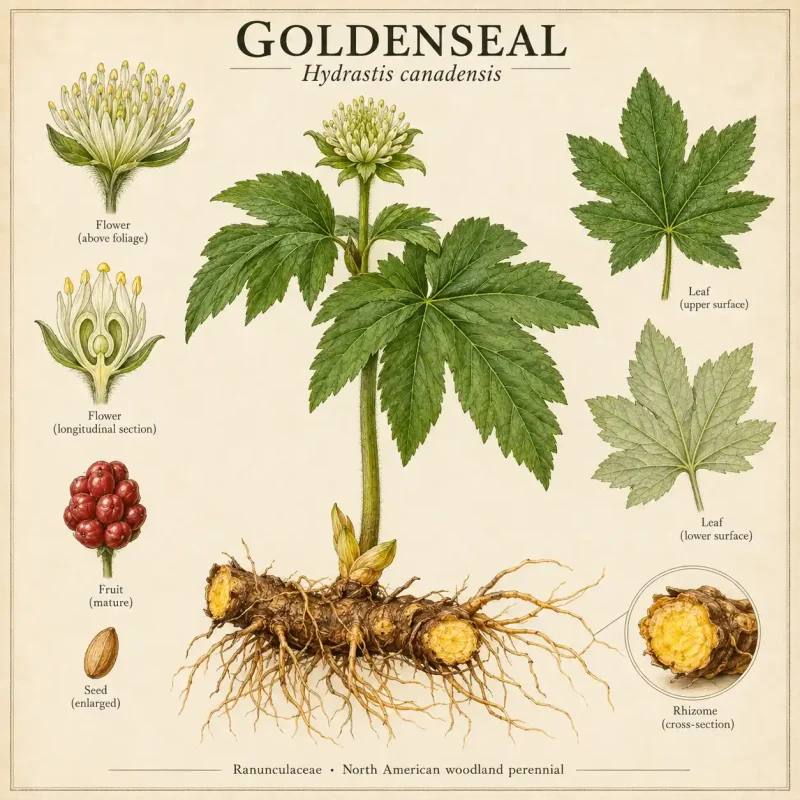
The plant grows from a thick, knotted rhizome with slender roots extending from its underside. The outside of the rhizome is brownish, while the inside is naturally bright yellow. This color comes largely from berberine, one of the plant’s characteristic alkaloids.
Goldenseal typically grows 20–50 cm tall. Its upright stem is covered with fine hairs and generally supports one or two large, palm-shaped leaves. Mature leaves commonly have 3 to 9 toothed lobes, while younger plants may produce only one leaf.
In spring (typically April–May, sometimes into June), goldenseal produces a small, solitary white flower. The flower has no petals and consists mainly of numerous stamens surrounded by small sepals. After flowering, the plant develops a red, raspberry-like fruit that usually contains 10–30 small black seeds. Although attractive, the fruit is not edible.
Common names
Goldenseal is also known as:
- Yellow root
- Goldenroot
- Yellow puccoon (or yellow pucoon)
- Orangeroot
- Ground raspberry
- Eye balm
- Yellow paint root
- Indian turmeric
- Wild turmeric
- Jaundice root
- Yelloweye
- Indian dye
Some common names overlap with those of unrelated plants, so the botanical name is the most reliable way to identify the species.
Quick Facts
| Attribute | Details |
|---|---|
| Botanical name | Hydrastis canadensis L. |
| Family | Ranunculaceae (buttercup family) |
| Also known as | Goldenseal, yellow root, goldenroot, yellow puccoon, orangeroot, Indian turmeric |
| Plant part used | Goldenseal rhizome and roots |
| Growth habit | Clumping herbaceous perennial |
| Leaves | One or two palmately lobed, toothed leaves on fertile plants, with 3 to 9 lobes each |
| Flower | One white, petal-less flower, open in spring (typically April–May) |
| Fruit | Crimson, raspberry-like berry with 10–30 small black seeds, ripe June to August, inedible |
| Habitat | Goldenseal favors moist to mesic, nutrient-rich hardwood forest in deep to partial shade |
| Key alkaloids | Hydrastine, berberine, canadine, berberastine, hydrastinine, canalidine |
| Taste | Sharp, earthy, deeply bitter |
02. Plant Identification
Distinctive features
Distinctive features
Goldenseal can be recognized by the following characteristics:
- A yellow, irregularly knotted rhizome
- A hairy, upright flowering stem
- One or two palmately lobed leaves with toothed edges (3–9 lobes)
- A small, petal-less white flower in spring
- A red, raspberry-like fruit that develops during summer (containing 10–30 seeds)
- A sharp, deeply bitter taste in the dried root
Goldenseal should not be confused with goldenrod (Solidago), shrub yellowroot (Xanthorhiza simplicissima), Oregon grape, or Chinese goldthread. Some of these plants contain berberine, but they are different species and may have different chemical profiles.
The rhizome and roots are the parts traditionally collected for herbal preparations. The above-ground shoots are not considered equivalent to the root and rhizome in commercial quality standards.
03. Habitat and Range
Where goldenseal grows
Goldenseal naturally occurs in rich, moist to mesic hardwood forests, especially in shaded coves, stream valleys, hillsides, and areas with deep leaf mold. It prefers well-drained soil with abundant organic matter and often grows beneath a mixed deciduous canopy.
Its main range extends across the eastern United States and into southeastern Canada. The Ohio River Valley and parts of the Appalachian region are considered important areas within its natural range.
Goldenseal grows best in:
- Deep or partial shade
- Moist but well-drained forest soil
- Soil rich in organic matter
- Protected woodland locations
- Areas with limited disturbance
The plant is slow growing. Flowering may begin after approximately four to five years, depending on growing conditions. It spreads through both seed and rhizome growth.
04. Cultivation and Harvesting
Growing considerations
Goldenseal is commonly cultivated in woodland settings that replicate its natural environment. It may be grown using rhizome divisions or through seed, although seed germination can be slow and inconsistent.
For cultivation, choose a location with:
- Filtered shade or a dense woodland canopy
- Moist, fertile soil
- Good drainage
- Plenty of organic matter
- Protection from excessive heat and direct sunlight
Rhizome pieces with viable buds and roots are generally used for propagation. Because goldenseal develops slowly, growers must allow several years before the roots reach a suitable harvest size.
Harvesting and storage
The rhizome and roots are typically harvested after the plant has matured and the above-ground growth begins to die back in late summer or autumn. Responsible harvesting should leave younger plants and part of the rhizome colony undisturbed so the population can regenerate.
After harvesting, the roots are cleaned, dried, and prepared as whole pieces, cut root, or powder. Store dried goldenseal in an airtight, opaque container in a cool, dry place. Protecting it from moisture and strong light helps preserve its quality.
Wild goldenseal populations have been reduced by habitat loss and overharvesting. The species is listed in CITES Appendix II, which regulates international trade in the plant and its roots.
05. Root Compounds and Traditional Use
Natural constituents
Goldenseal root and rhizome contain several isoquinoline alkaloids, including:
- Berberine
- Hydrastine
- Canadine
- Berberastine
- Hydrastinine
- Canalidine
Berberine contributes to the root’s yellow color, while the combined alkaloids contribute to its strongly bitter taste. Because berberine also occurs in other plants, hydrastine is useful when confirming the identity of goldenseal root. Quality testing may use methods such as thin-layer chromatography or high-performance liquid chromatography. (Source: ncbi.nlm.nih)
Traditional use
Goldenseal has a long history of traditional use among Indigenous peoples of eastern North America. Historical herbal references describe the root as a bitter botanical traditionally used for digestive support and in preparations for the skin.
These historical uses do not establish that goldenseal can diagnose, treat, cure, or prevent a disease. Modern evidence for many popular goldenseal claims remains limited, and goldenseal should not be promoted with unsupported disease or infection claims.
Product disclaimer
For educational purposes only. This information has not been evaluated by the U.S. Food and Drug Administration. It is not intended to diagnose, treat, cure, or prevent any disease. Consult a qualified healthcare professional before making changes to your diet or using herbal products, especially if you take medication or have an existing health condition.